
Phase Plant · Deep, minimal bass · Recreation
How to Make a Bass Like Alix Perez in Phase Plant (Deep, Minimal DnB)
To make a deep, minimal bass in the style of Alix Perez in Phase Plant, start with a sine wave whose phase is modulated by a saw, then let LFOs move two filters so the upper harmonics only open up at certain points in the bar. Distortion, a Slice EQ boost, a Disperser and a foldback stage give it grit and movement, and pitch and LFO-rate automation keep it alive. Below is our own recreation, presented by Paulo from DNB Academy, with the settings from the screen and audio of each stage.
This is a learning recreation in the style of Alix Perez, not an original sound or preset from the artist. The point is the technique: a simple FM-style source, filters driven by LFOs, and movement you can automate. For every bass type in one place, see our drum and bass bass guide.
Quick answer
How do you make a bass like Alix Perez in Phase Plant?
Load an analog oscillator as a sine and use a second, saw oscillator placed below the output module to modulate its phase, with the saw’s harmonic raised. Run it through a low-pass filter moved by a unipolar LFO, then an Overdrive distortion and a Slice EQ boost on the low harmonics. Add a Disperser for movement and a foldback distortion at a lower mix. Finish with a second, steeper filter whose cutoff follows a synced LFO, so the top end only opens on parts of the sequence, then automate the pitch and the LFO rate.
- Source.A sine, phase-modulated by a saw.
- Filter + LFO.A unipolar LFO on the cutoff.
- Grit.Overdrive, then a low-harmonic EQ boost.
- Movement.Disperser and a foldback stage.
- Rhythm.A second filter on a synced LFO.
- Life.Pitch and LFO-rate automation.
The full walkthrough with Paulo from DNB Academy: a deep, minimal bass in the style of Alix Perez, built from an initialised Phase Plant patch and finished in Ableton Live. Each step below links to its moment in the video.
What you’ll need
- Phase Plant. The patch uses two analog generators, two filters, two distortions, a Slice EQ and a Disperser, all inside one Phase Plant instance, plus three LFOs. Don’t have it? Vital is free and has phase modulation from one oscillator to another, filters and drawable LFOs, so the same ideas carry over.
- A DAW that can automate plug-in parameters. The video uses Ableton Live (the project runs at 172 BPM) to automate Phase Plant’s pitch wheel and mod wheel, then EQ Eight, an Audio Effect Rack and Reverb for the post-processing.
- A short, sparse bass pattern. Deep, minimal basses live on space. A couple of long notes per bar is plenty, because most of the movement comes from the LFOs.
1.Start with a sine, phase-modulated by a saw
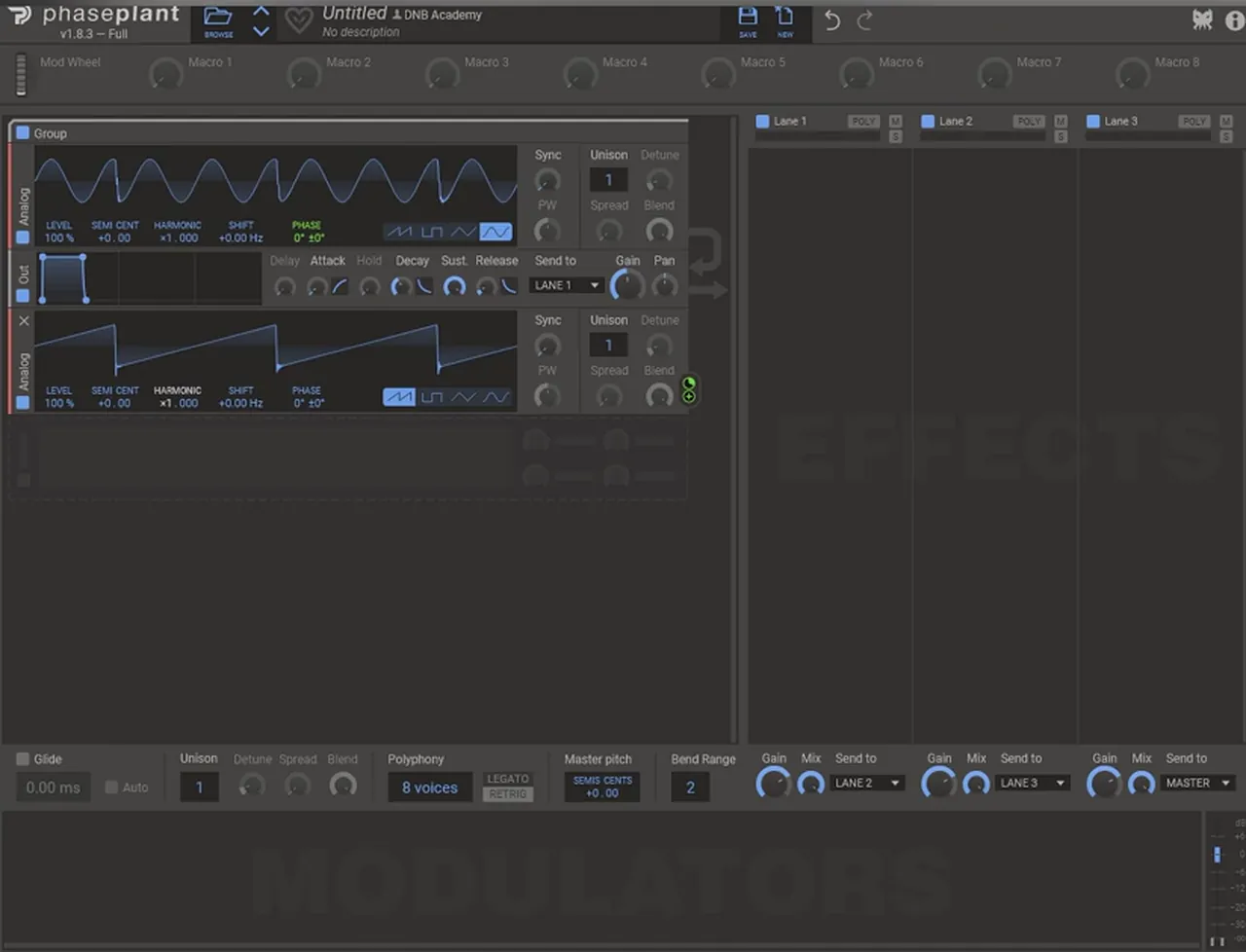
The core tone is a sine wave whose phase is pushed around by a saw. That gives you a clean low end with a set of extra harmonics on top, which is exactly the kind of sound the later filters and distortion can shape.
From an initialised patch (watch at 0:16), add an analog generator and switch it to a sine. Then add a second analog generator below the output module, leave it as a saw, and use it to modulate the phase of the first oscillator. Because it sits below the output, the saw isn’t heard directly; it only shapes the sine. Next, raise the saw’s harmonic (watch at 0:40): on screen it ends up at ×2, which changes the character of the modulation straight away.
2.Add a filter and move it with an LFO
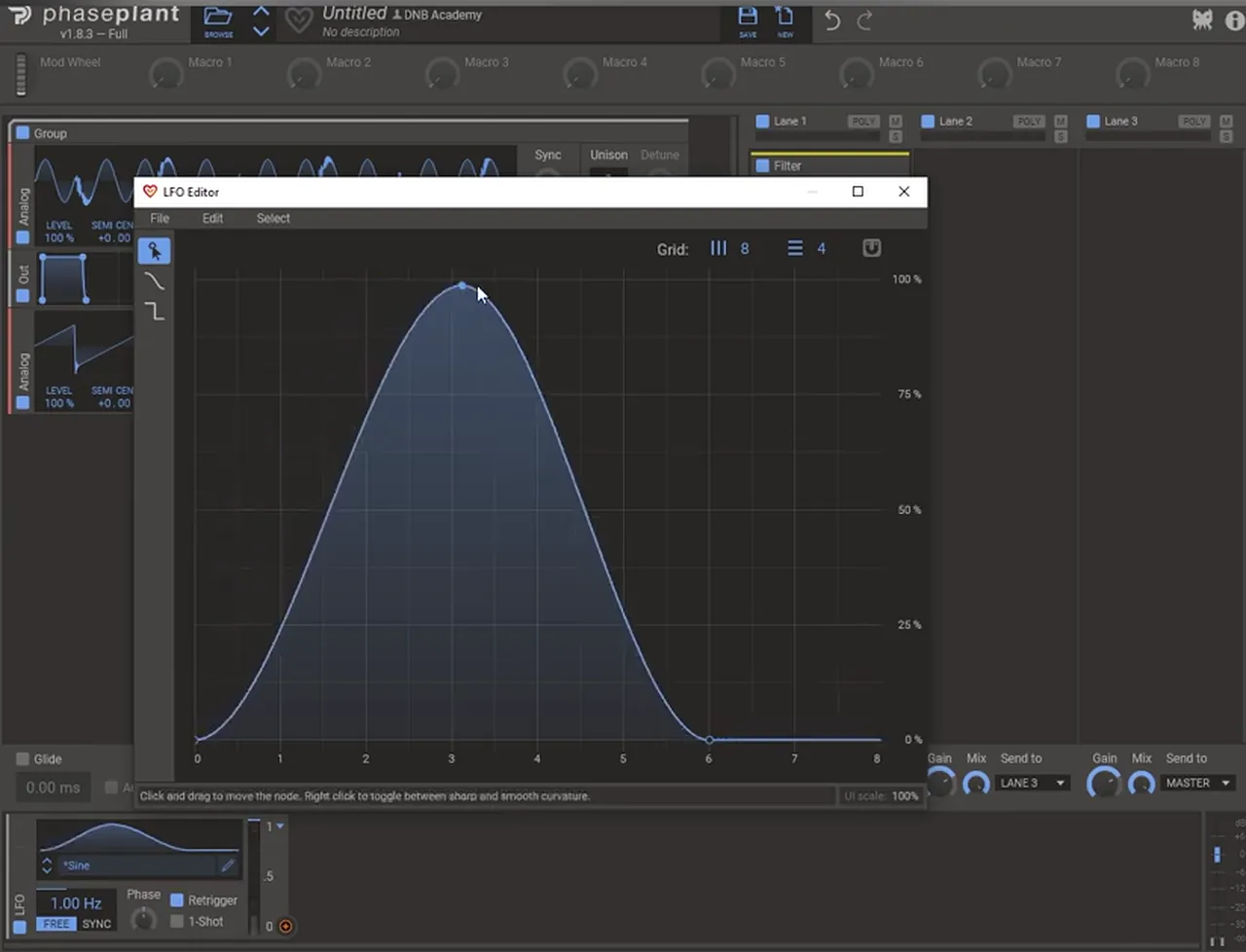
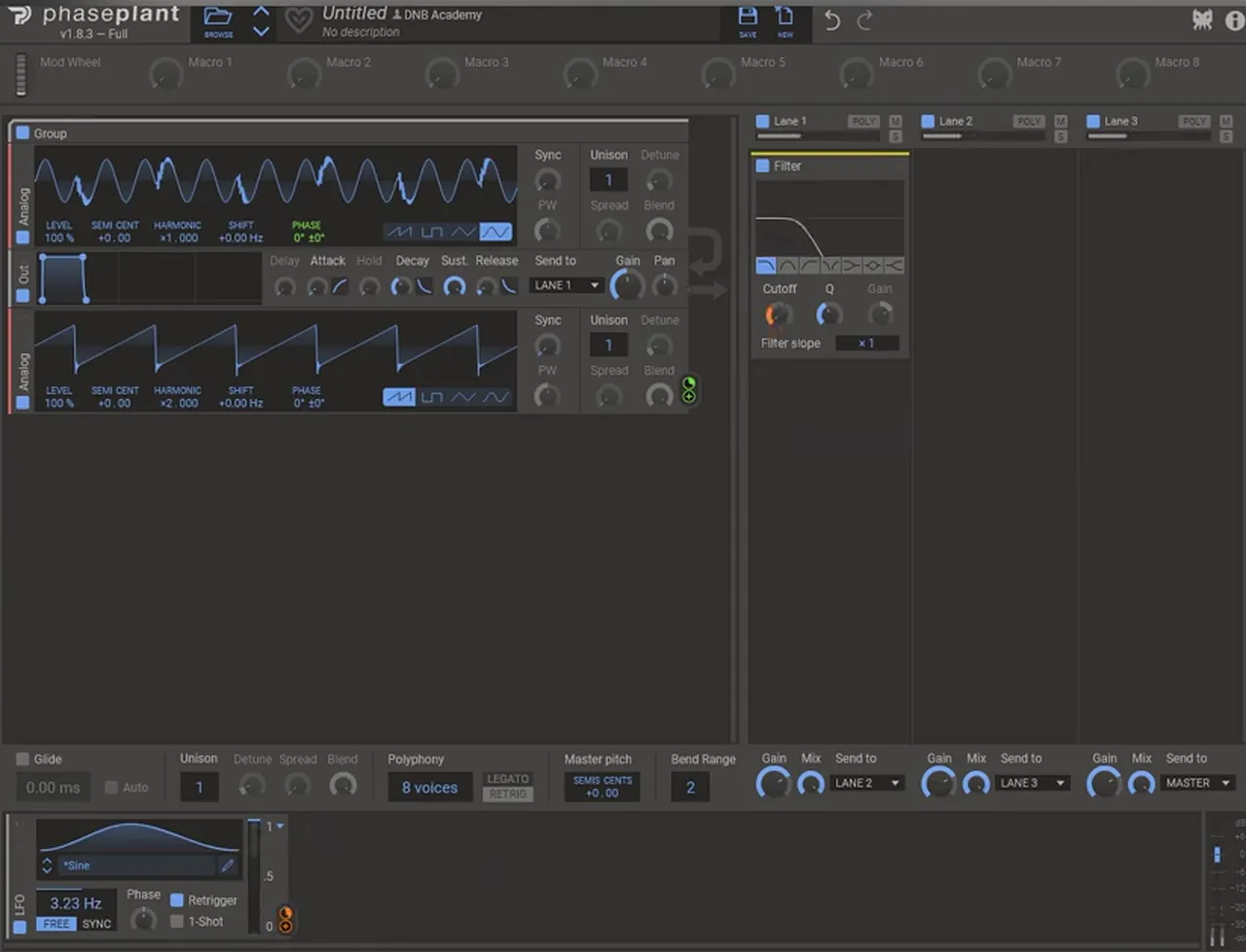
A low-pass filter tames the new harmonics, and a unipolar LFO with a custom shape opens and closes it. This is where the bass starts to breathe instead of sitting still.
Add a Filter (low-pass) and play with the cutoff (watch at 0:48). Then add an LFO, set it to unipolar, draw a smooth rise-and-fall shape in the LFO editor and map it to the cutoff. After that, play with the LFO rate until the movement suits your pattern; on screen the LFO runs free at 3.23 Hz.
Listen: the phase-modulated sine through the LFO-driven filter8 sec
3.Drive it with Overdrive, then boost the low harmonics
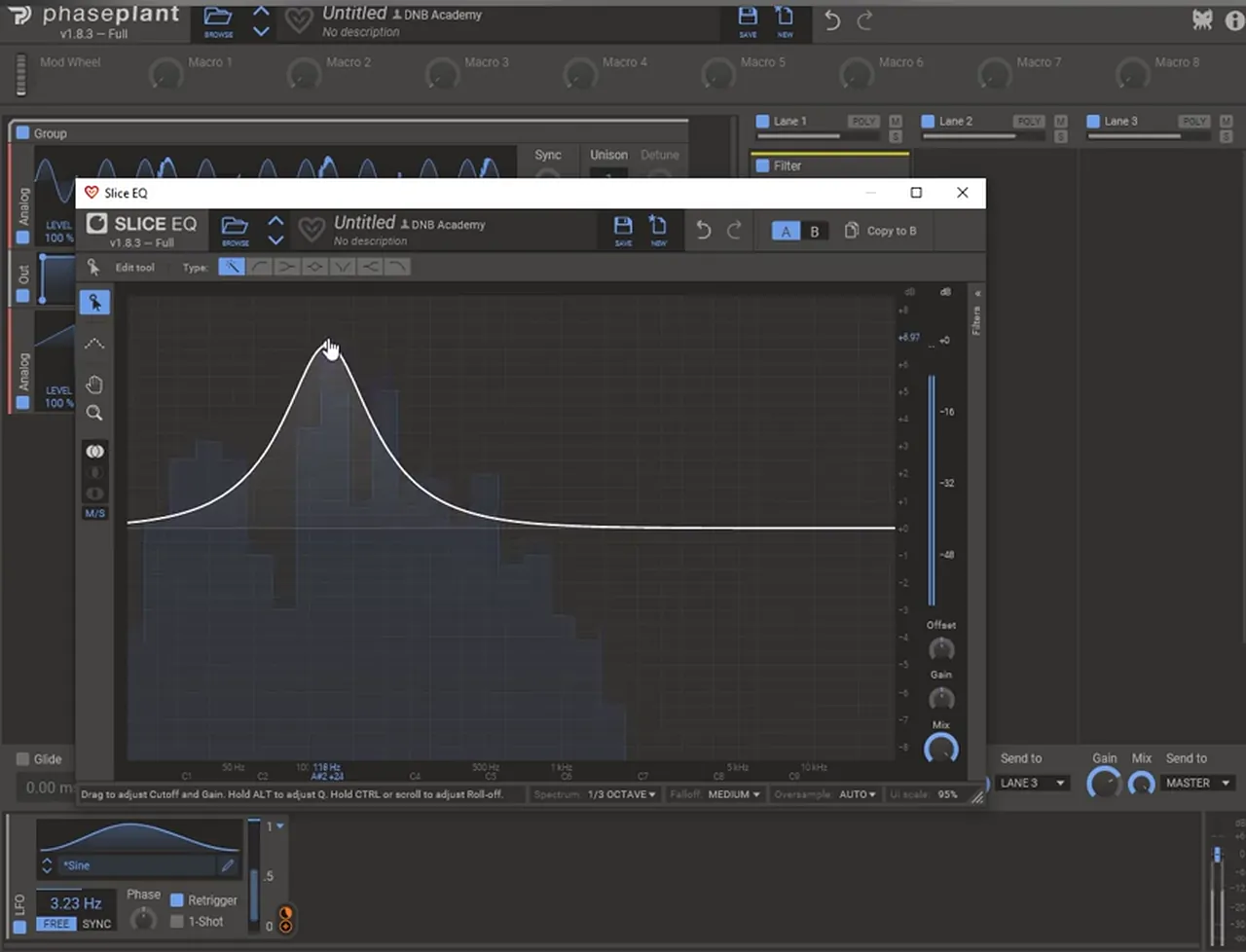
Distortion adds the weight and grit, and an EQ boost after it brings the lower harmonics forward so the bass feels fuller on smaller speakers.
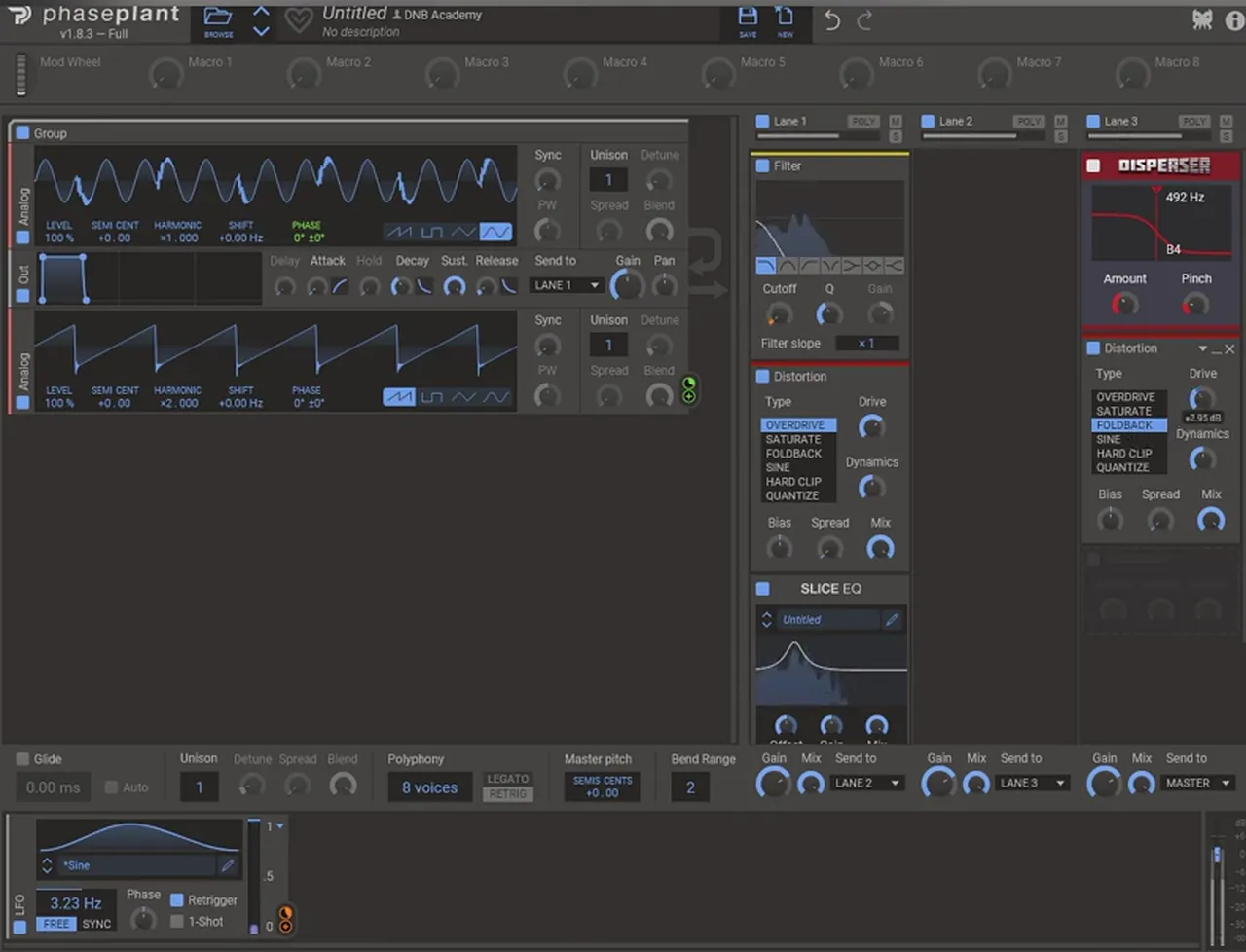
Add a Distortion module (it’s on Overdrive on screen) and boost the drive (watch at 1:12). Then add a Slice EQ and boost some of the lower harmonics. In the video the boost is a single bell around 118 Hz, at roughly +7 dB.
4.Add movement with a Disperser and a foldback stage
A Disperser smears the phase of the harmonics so the tone moves and swirls, and a second distortion on foldback, mixed in lower, adds a bit more bite without taking over.
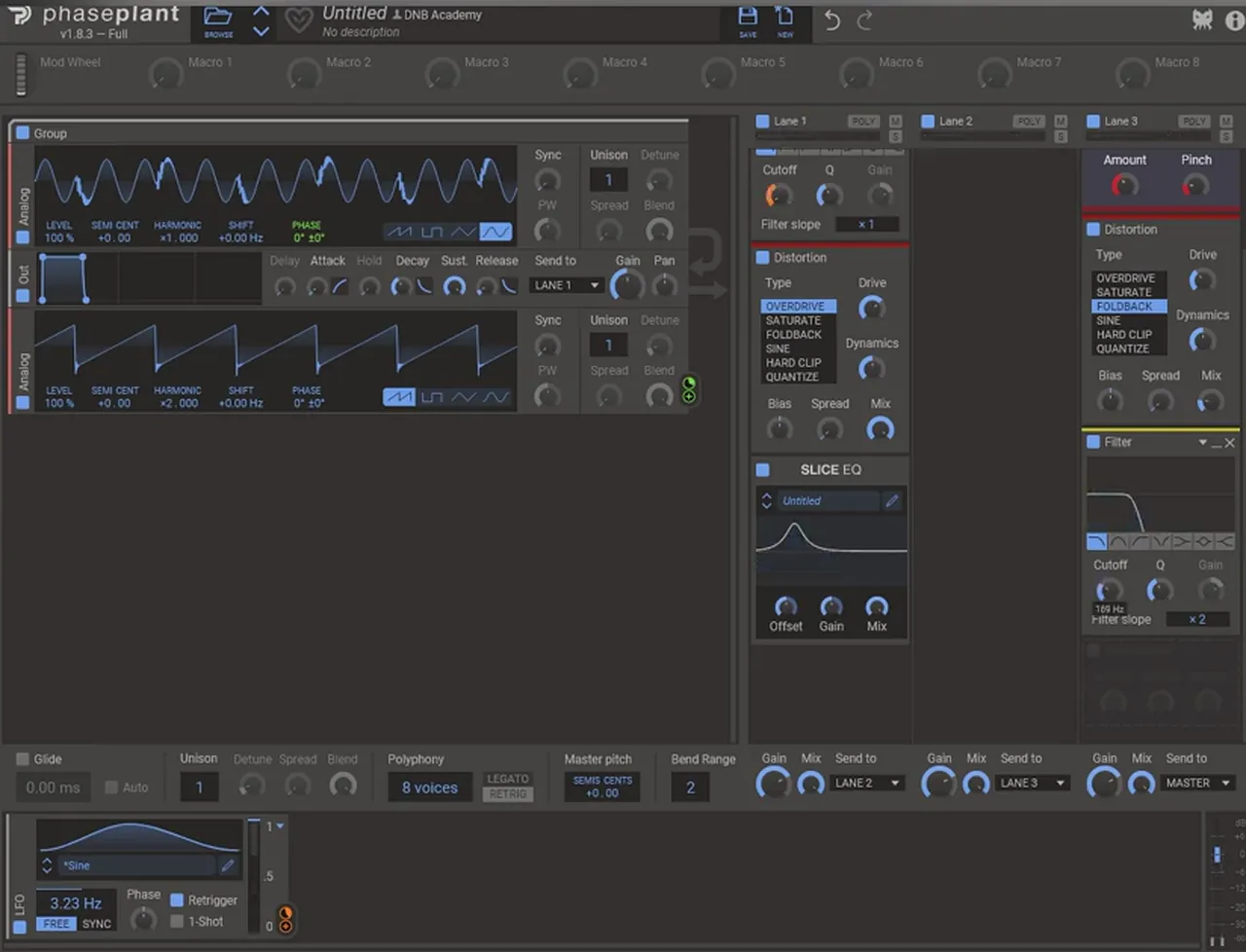
Add a Disperser (watch at 1:51). You can experiment a lot with this one; in the video Paulo adds a little pinch and brings the amount down, and the frequency reads 492 Hz on screen. Then distort the sound a bit more: add another Distortion, set it to Foldback and bring its mix lower so it blends in.
Listen: the bass with distortion, Slice EQ and the Disperser6 sec
5.Gate the top end with a second filter on a synced LFO
This is the step that makes the bass feel rhythmic. A second, steeper low-pass sits fairly low, and a tempo-synced LFO opens it only at certain points, so the upper harmonics pass on some parts of the sequence and not others.
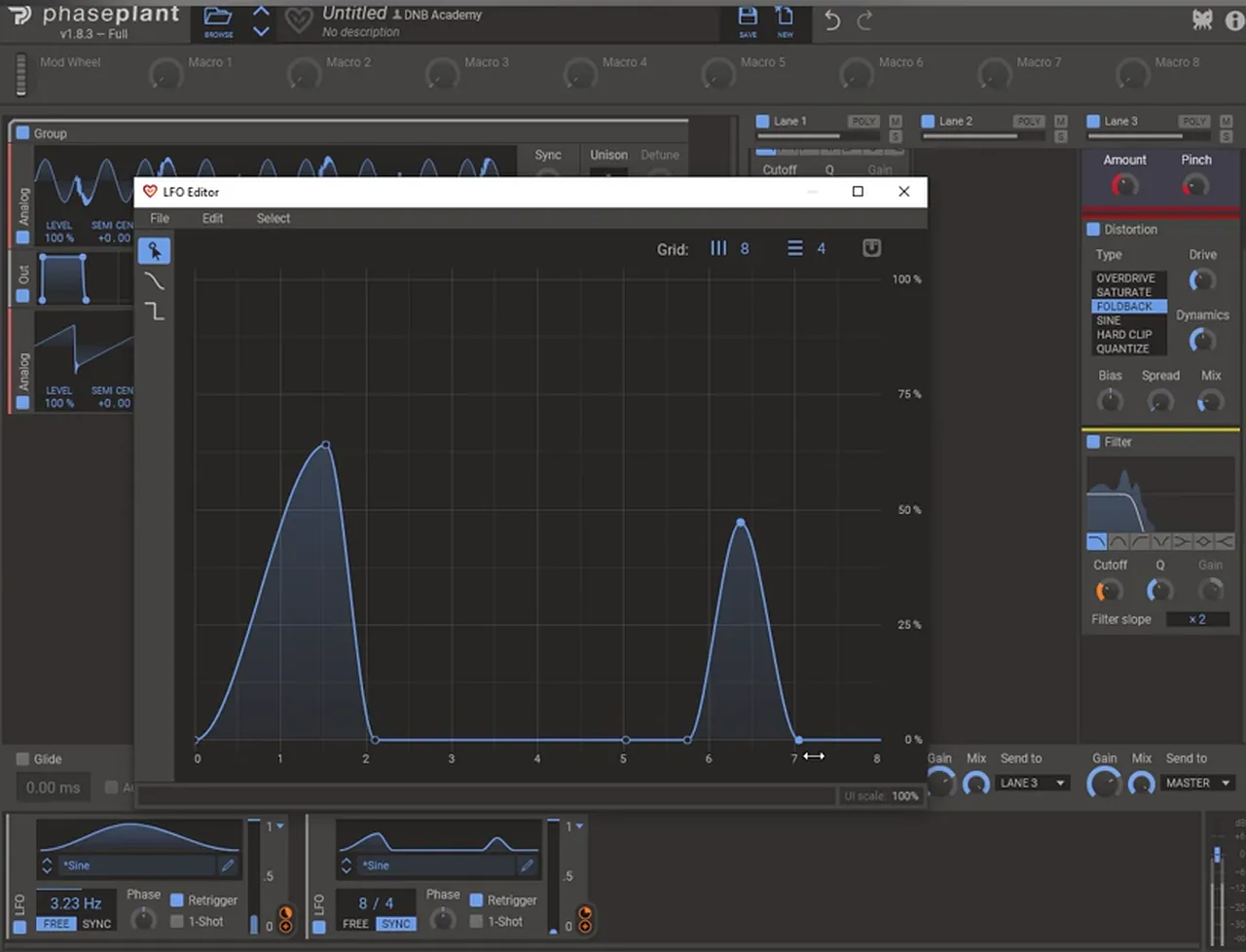
Add another Filter, change the slope to ×2 and set the cutoff fairly low (watch at 2:19). Automate it with another LFO: make it unipolar, switch it to sync (8/4 on screen) and draw a shape that lets the upper harmonics through only on parts of the sequence. In the video that’s one peak near the start and a second, smaller peak later on.
Listen: the bass with foldback and the second, LFO-driven filter9 sec
6.Automate the pitch and the LFO rate
Small pitch movements and a changing LFO speed stop a minimal bass from looping in an obvious way. Both are automated from the DAW, so they can change from bar to bar.
Add some pitch modulation by automating the pitch (watch at 3:30). In the video this is an automation lane on Phase Plant’s pitch wheel in Ableton Live, drawn as a zigzag of ramps up and down (the patch’s bend range reads 2 on screen).
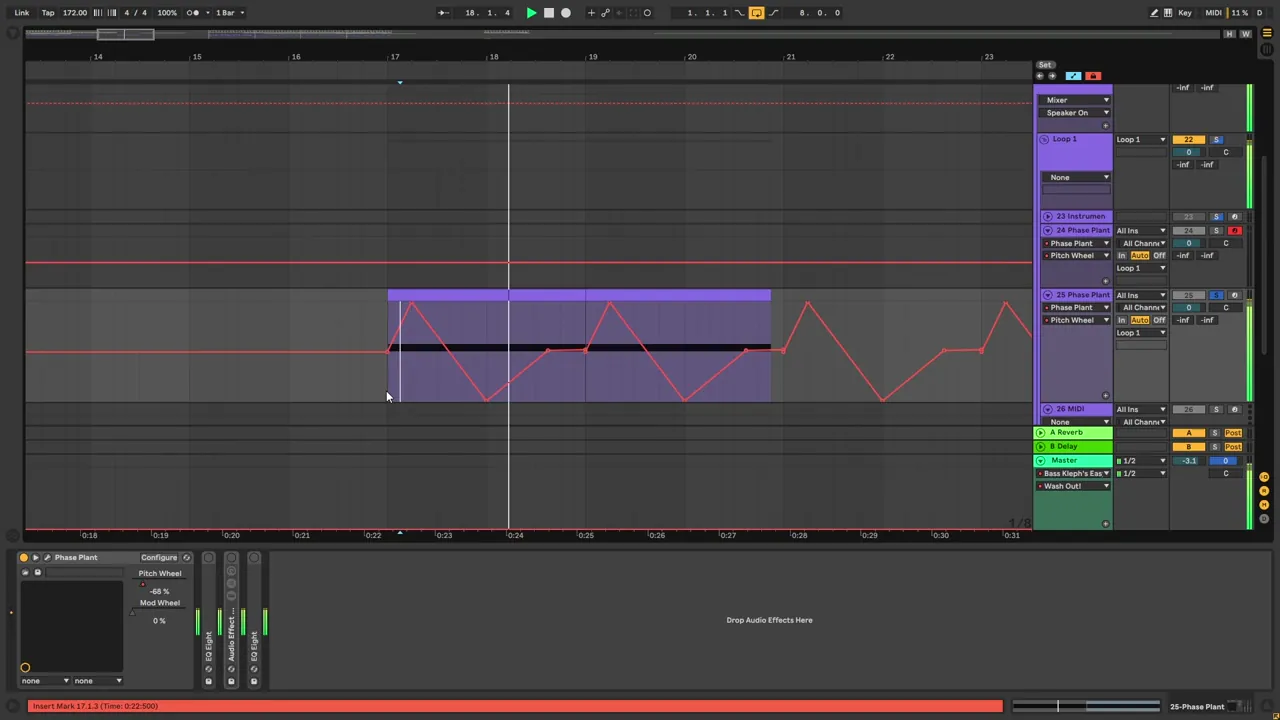
Then play with the rate (watch at 3:48). Map the mod wheel to the rate of the filter LFO so that raising it brings the rate down, and automate the mod wheel in your DAW. On screen the rate drops to around 2.79 Hz while Paulo moves it.
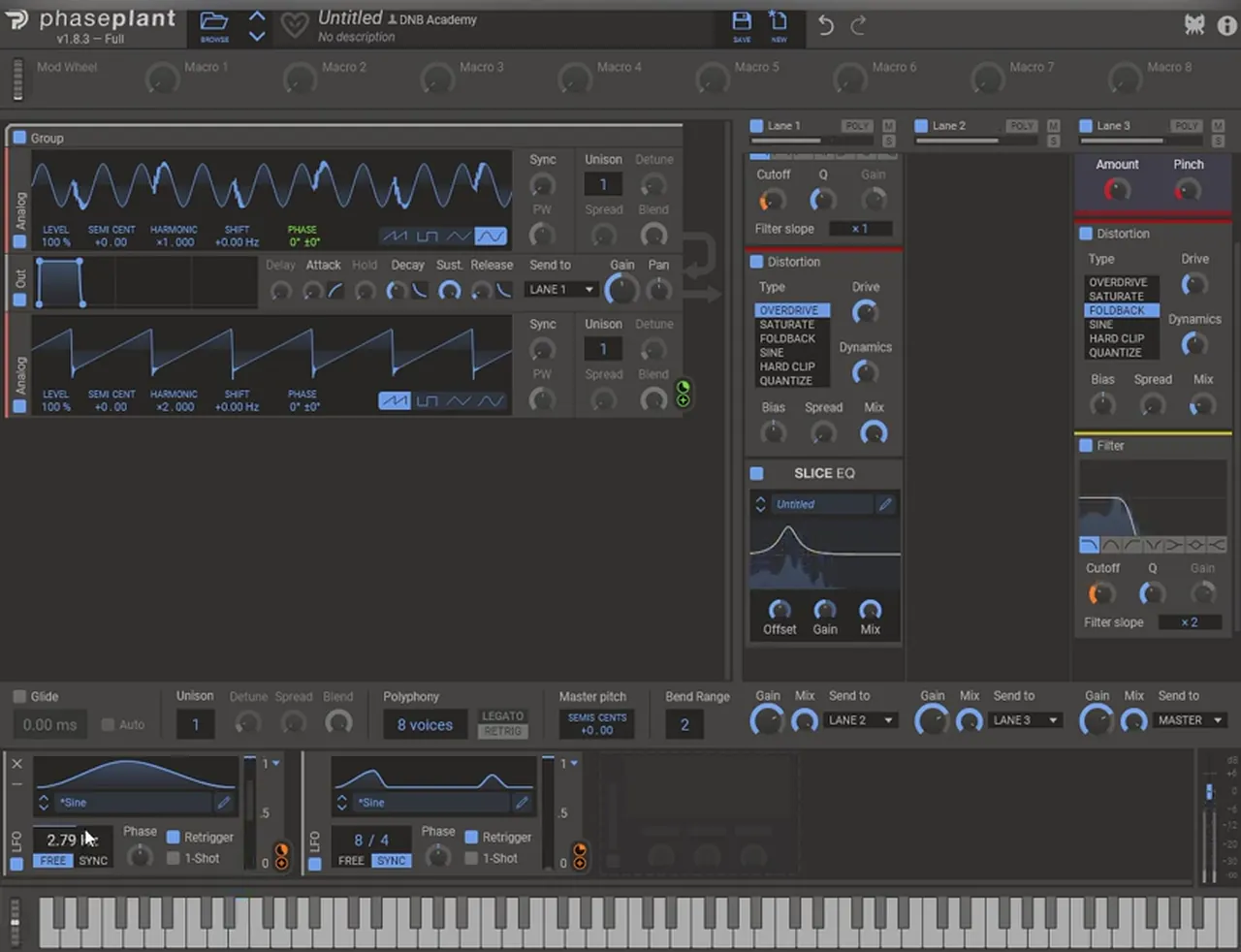
Listen: the full Phase Plant patch with the mod wheel slowing the LFO5 sec
7.Post-process: tame resonances and add space to the mids
That’s the whole patch. Outside the synth, an EQ removes harsh resonances, then the sound is split so only the mid harmonics get reverb and the low end stays dry.
First, EQ out some of the very strong resonances (watch at 4:18); on screen EQ Eight has a cut around 230 Hz at about −5.8 dB. Then split the signal with an Audio Effect Rack of two chains. One chain keeps the low end (an EQ Eight with a low-pass). The other chain high-passes the signal (178 Hz on screen) to separate the mid harmonics and sends them into a Reverb, so the space never muddies the sub. If you want to go further with low-end control, our DnB sub bass guide covers it in detail.
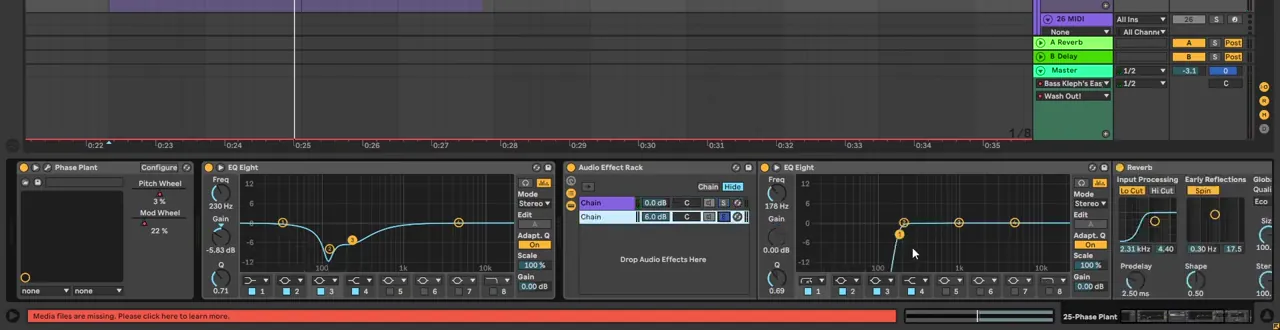
For where a bass like this sits among the styles, see the deep and minimal section of our subgenres guide. For two more deep, minimal sounds built in Serum, try our basses like Alix Perez & Skeptical guide.
Common mistakes with deep, minimal basses
- Letting the modulator be heard. The saw should only modulate the sine’s phase. Place it below the output module so it doesn’t go to the output on its own.
- A static filter. Without the LFO on the cutoff, the patch sounds flat. The movement is the sound.
- Too much foldback. Foldback gets harsh fast. Bring the mix down so it adds bite underneath the main tone.
- A bipolar LFO on the second filter. The video switches it to unipolar so the filter only opens upwards from its low setting, on the parts of the bar you choose.
- Looping the same bar. Automate the pitch and the LFO rate so each phrase moves a little differently.
- Reverb on the sub. High-pass the chain that feeds the reverb so the low end stays dry and focused.
Free download
Free samples to build a minimal loop
A sparse bass like this only makes sense next to drums and space. The 174 Marathon Sample Pack gives you:
- 100+ royalty-free samples
- Drums, bass, FX, melodics and more
- Audio samples, so they work in Ableton Live or any other DAW
- Made for International Drum & Bass Day and our 174 Production Marathon
It’s one of seven free sample and preset packs in DNB Academy Free Access, alongside the mixing and mastering e-books and the 3‑day DnB challenge. Join 40,000+ producers in Free Access. Free account, no card needed.
Go deeper
Deep, minimal courses and sounds
Want a full deep, minimal track from start to finish, or ready-made sounds to study?
 Production courseArkaik production courseMinimalist drum and bass in Logic Pro X: a 6+ hour start-to-finish course, from bass presets and drum processing to the mixdown, with the samples, presets, project file and stems.
 Sample packArkaik sample packDark, stripped-back sounds: 19 bass one-shots, 16 bass loops, 30 pads, drum one-shots, loops and FX.
 Preset bundleGEST Serum presets100 Serum presets for techy, deep DnB, including 35 basses, 12 pads and 7 stabs, plus WAV files of the presets.
Every artist course, preset bundle and sample pack is also in The Vault. Browse courses
Related tutorials
All tutorials → Serum · Deep minimalHow to Make Basses Like Alix Perez & Skeptical in Serum10 min read · Video + guide
 Vital · Deep bassHow to Make a Deep Bass Like Skeptical’s “Desire” in Vital8 min read · Video + guide
 Phase Plant · RecreationHow to Make a Bass Like Mefjus’ “Hear Me” in Phase Plant10 min read · Video + guide
 Guide · BassHow to Make Drum and Bass Bass: A Guide to Every Bass Type15 min read · Video + guide
FAQ: making a bass like Alix Perez in Phase Plant
How do you make a bass like Alix Perez in Phase Plant?
Our recreation starts with an analog sine whose phase is modulated by a saw placed below the output module, with the saw’s harmonic raised. A low-pass filter moved by a unipolar LFO, an Overdrive distortion, a Slice EQ boost on the low harmonics, a Disperser and a foldback distortion shape the tone. A second, steeper filter on a synced LFO lets the top end through only on parts of the sequence, and pitch and LFO-rate automation keep it moving.
Is this Alix Perez’s actual bass or preset?
No. It’s our own recreation in the style of Alix Perez, built from an initialised Phase Plant patch by Paulo from DNB Academy. The aim is to learn the techniques behind deep, minimal basses, not to copy a specific sound.
Why put the saw below the output module?
In Phase Plant, a generator below the output module isn’t sent to the output, so you don’t hear it directly. Here the saw only modulates the phase of the sine above it, which adds harmonics to the sine without adding a raw saw to the sound.
What does the second filter LFO do?
It’s set to unipolar and synced (8/4 on screen), with a drawn shape of two peaks. Because the second filter sits fairly low, the upper harmonics only pass when the LFO peaks, so the top end opens on certain parts of the sequence and gives the bass its rhythm.
Can I make this bass in Vital or Serum?
Yes. Vital, which is free, and Serum both offer phase or FM modulation between oscillators, filters, distortion and drawable LFOs. Phase Plant’s Disperser and Slice EQ have equivalents in most DAWs, so the same steps carry over.
How is the bass post-processed?
In the video, an EQ cuts the strongest resonances, then an Audio Effect Rack splits the sound into two chains. One keeps the low end, and the other high-passes the signal and sends the mid harmonics into a reverb, so the space doesn’t muddy the sub.
Next steps
Build the source and the first filter LFO, then write a short, sparse pattern and add the synced second filter; that’s where the groove comes from. For another Phase Plant recreation, try our bass like Mefjus’ “Hear Me”; for more bass types and when to use them, read our drum and bass bass guide.
Free Access
Seven free DnB sample and preset packs, including the 174 Marathon Sample Pack, plus mixing and mastering e-books and a 3-day challenge for Ableton Live and FL Studio.
Get free packsThe full guide
Tempo, drums, sub, mid bass, chords, arrangement and mixdown: every step of a DnB track.
Read the guideDNB Foundations
A structured drum and bass course with weekly live feedback calls on your tracks.
See Foundations1:1 Mentorship
Personal guidance on your music from a mentor, built around your goals.
See the mentorship50,000+ producers have joined DNB Academy, and our producer Discord has 5,300+ members.