
Neuro Bass Patterns: How to Write DnB Basslines with Call and Response
To write a neuro bass pattern, use call and response. Take a 2-bar loop: put a call bass on the first beat of bar 1, a fill or turnaround on the last beat of bar 2, and response basses in between. Repeat the pattern, change the sounds and tone rather than the rhythm, and finish the 8-bar phrase with a bigger turnaround. Here is the exact process from our video.
The full 12-minute walkthrough. Each step below matches a section of the video.
What you'll need
- A DAW. The video uses Ableton Live at 172 BPM, but the method is pure arrangement, so it works the same in FL Studio, Logic, Bitwig or any other DAW.
- A drop with drums and a build-up. This tutorial starts where many producers get stuck: drums laid down, but no idea what the bass should do. If you need a beat first, our neuro DnB tutorial takes you through drums and bass from scratch.
- A handful of bass sounds. Several different neuro basses on their own tracks (the project uses a set of Serum basses plus a sub). Presets are fine. The aim here is sequencing, not sound design.
- Reference tracks. A few neuro tunes you like, to study how they place their calls, responses and turnarounds.
1.Understand call and response
Call and response is a classic musical idea: one element calls, and another element answers. It's the bread and butter of writing bass patterns, and it solves the classic problem of having a big first hit and then not knowing what comes next.
Some spots in a phrase are perfect for certain jobs. Take a 2-bar period:
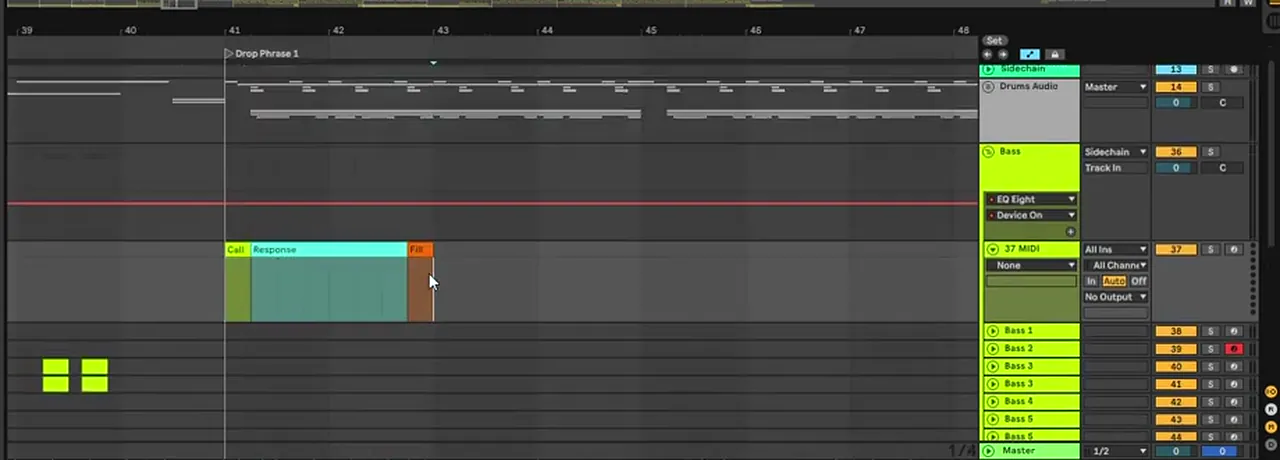
- The first beat of bar 1 is the perfect place for a call bass.
- The last beat of bar 2 is the perfect place for a fill or turnaround that prepares you for the repeat.
- Anything in between is the response.
You can build patterns in 1, 2 or 4-bar periods. The video uses 2 bars, because it's simple enough to learn the rules before you start breaking them. Colour-code the blocks (call, response, fill) so you can see the structure at a glance.
2.Build the first 2-bar pattern
With the blocks in place, start filling them with sounds you already have in the project:
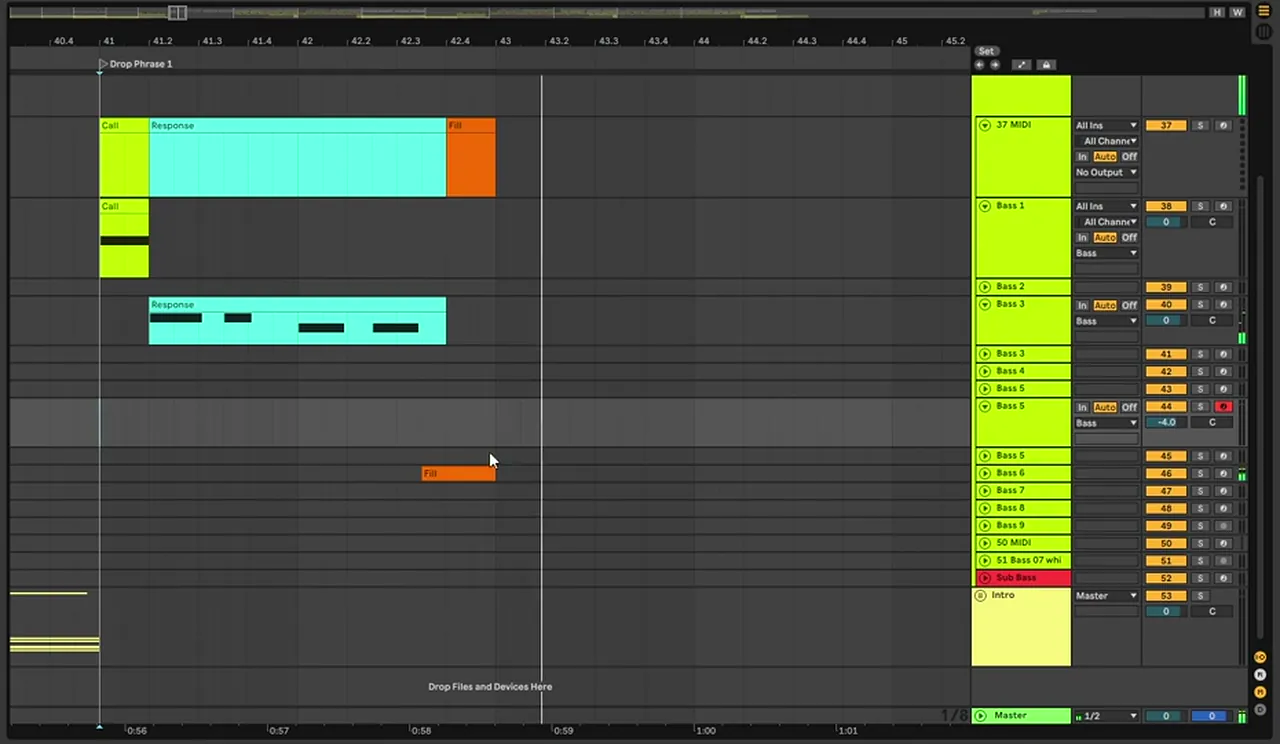
- Call: take the MIDI clip for the call and put it on your first bass.
- Response: place the response block on another bass (the third bass in the video) and experiment with a little riff. In the video, part of the riff is brought one semitone down, which already makes it feel like an answer to the call.
- Fill: put the fill on yet another sound and listen. Try playing it a bit earlier, and audition different basses until one clicks.
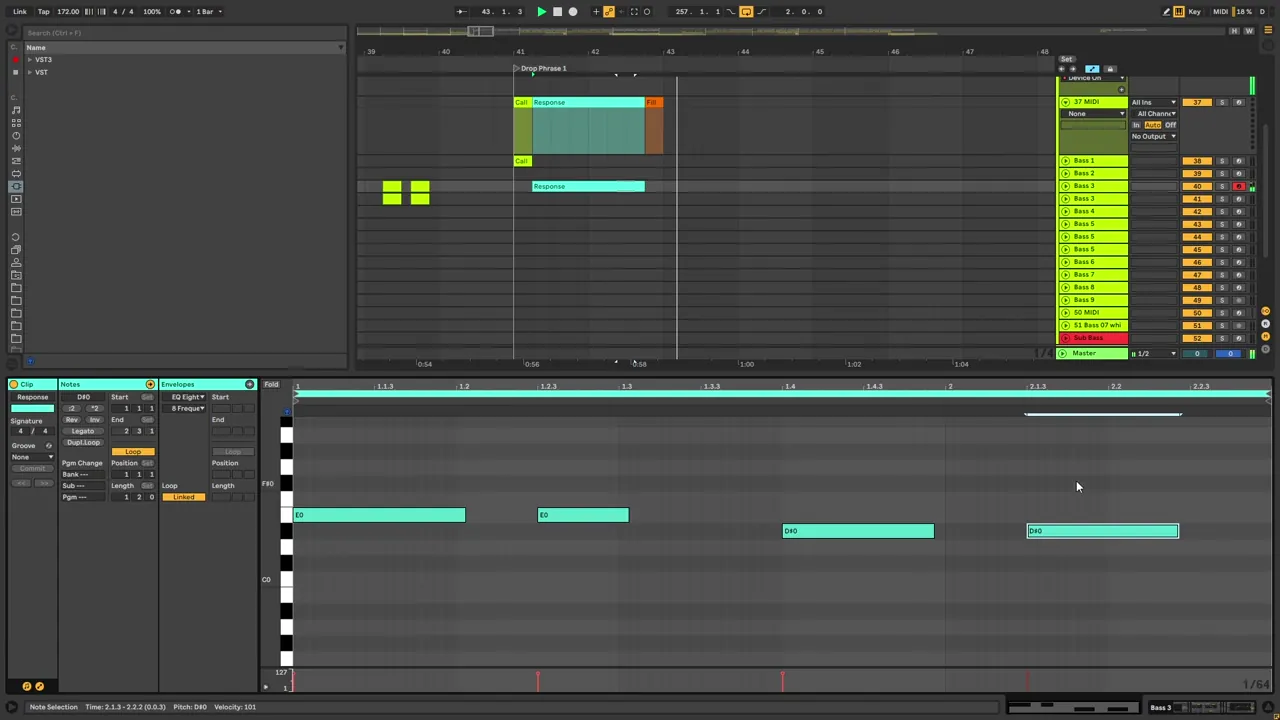
You now have a complete 2-bar pattern: a call on the first beat, a small riff as the response, and a fill at the end of the second bar.
3.Repeat it and vary the sounds
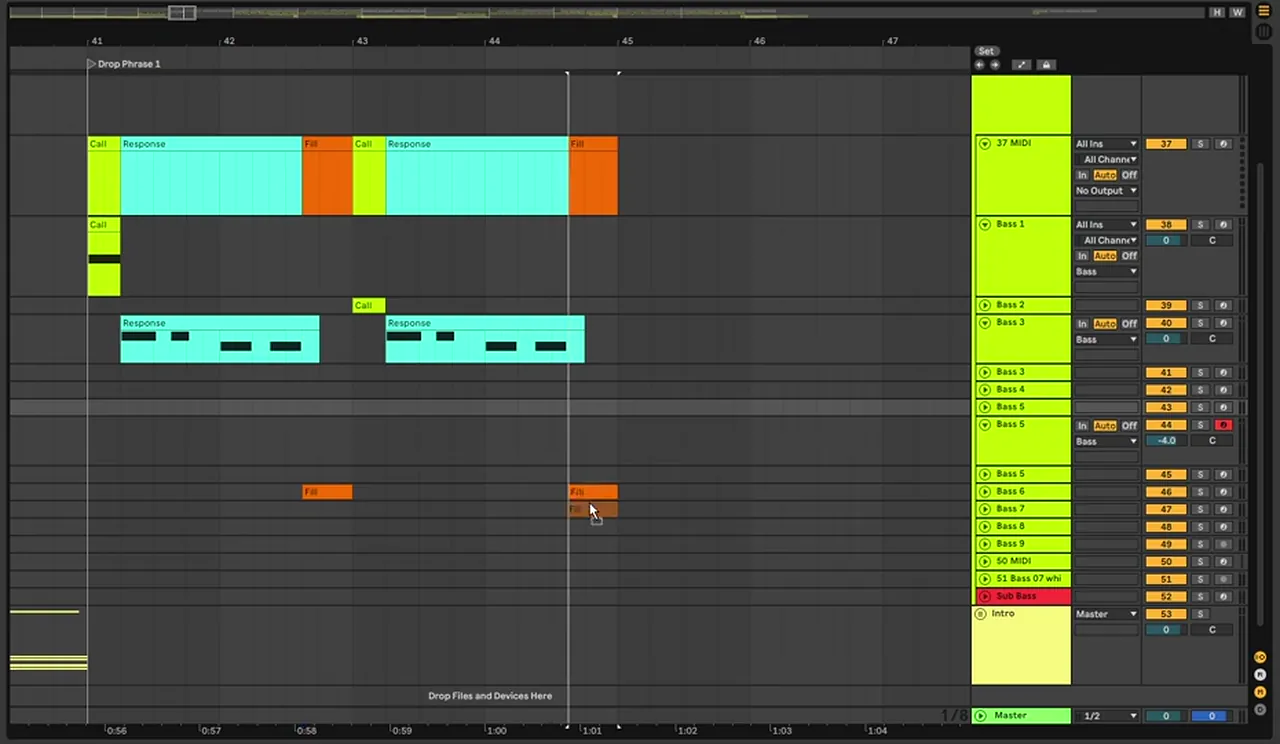
Once you have the pattern, repeat it and add small variations. The trick is to keep each element in the same position but change its tonality:
- Keep the call on beat 1, but move the second call onto a different bass. Two different sounds now serve the same function.
- Do the same with the fill: same spot, different sound.
Because the rhythm stays familiar, the listener can follow the groove. Because the sounds change, the drop doesn't get boring. You can use this technique to test any new sound: drop it into a block and see if it works in that role.
4.Layer the response and add the sub
Now add more layers to certain sections. The response is a good candidate:
- Copy the MIDI from the response and paste it onto another bass to layer the two.
- Make the layer different from the first sound by sustaining some notes. In the video the first attempt is too long, so it gets pulled back, and a different note is made longer instead. Listen and adjust until both layers have their own space.
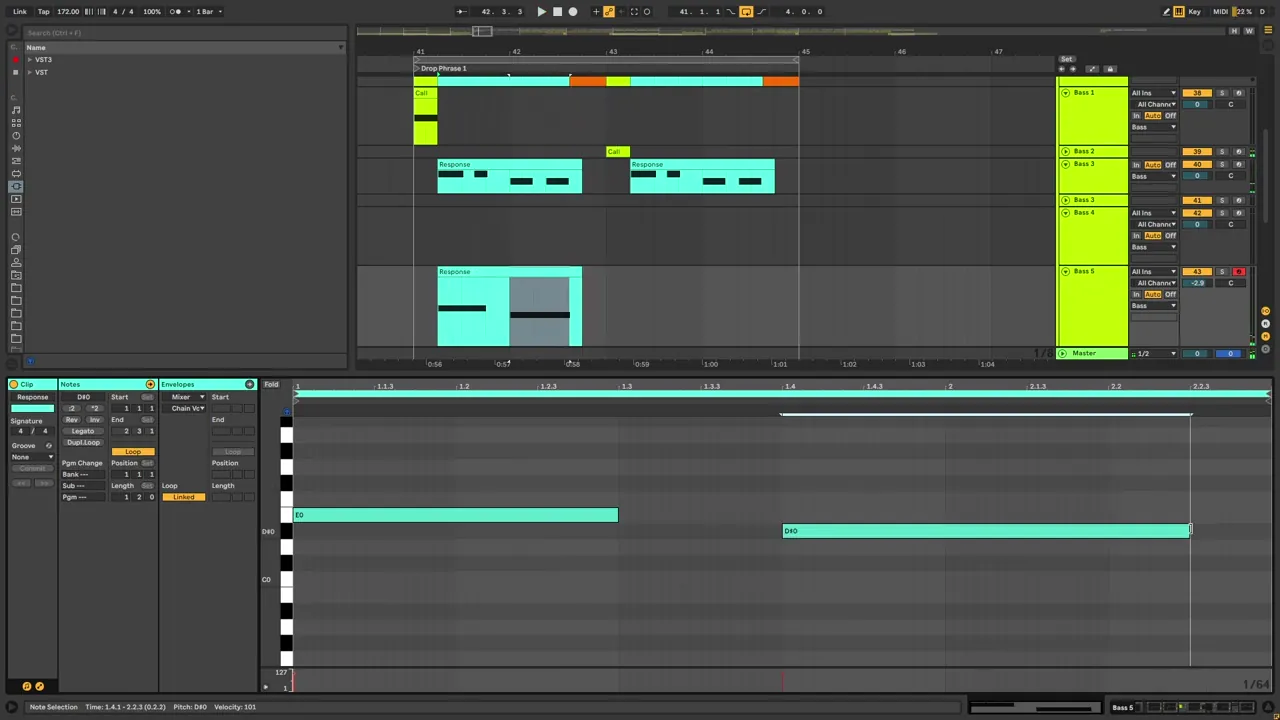
Before going further, copy the MIDI of everything onto the sub, so the low end follows every call, response and fill and the pattern sounds fuller. (For building a sub layer step by step, see the sub bass section of our neuro DnB tutorial.)
5.Change the response every 4 bars
Duplicate the pattern and vary the response the same way you varied the call and fill, but on a longer cycle. If the call and the fill change every 2 bars, the response can change every 4 bars. Simplified, your 8 bars then read like this:
| Bars | Call | Response | Fill |
|---|---|---|---|
| 1–2 | Sound 1 | Response A | Fill 1 |
| 3–4 | Sound 2 | Response A | Fill 2 |
| 5–6 | Sound 1 | Response B | Fill 1 |
| 7–8 | Sound 2 | Response B | Turnaround |
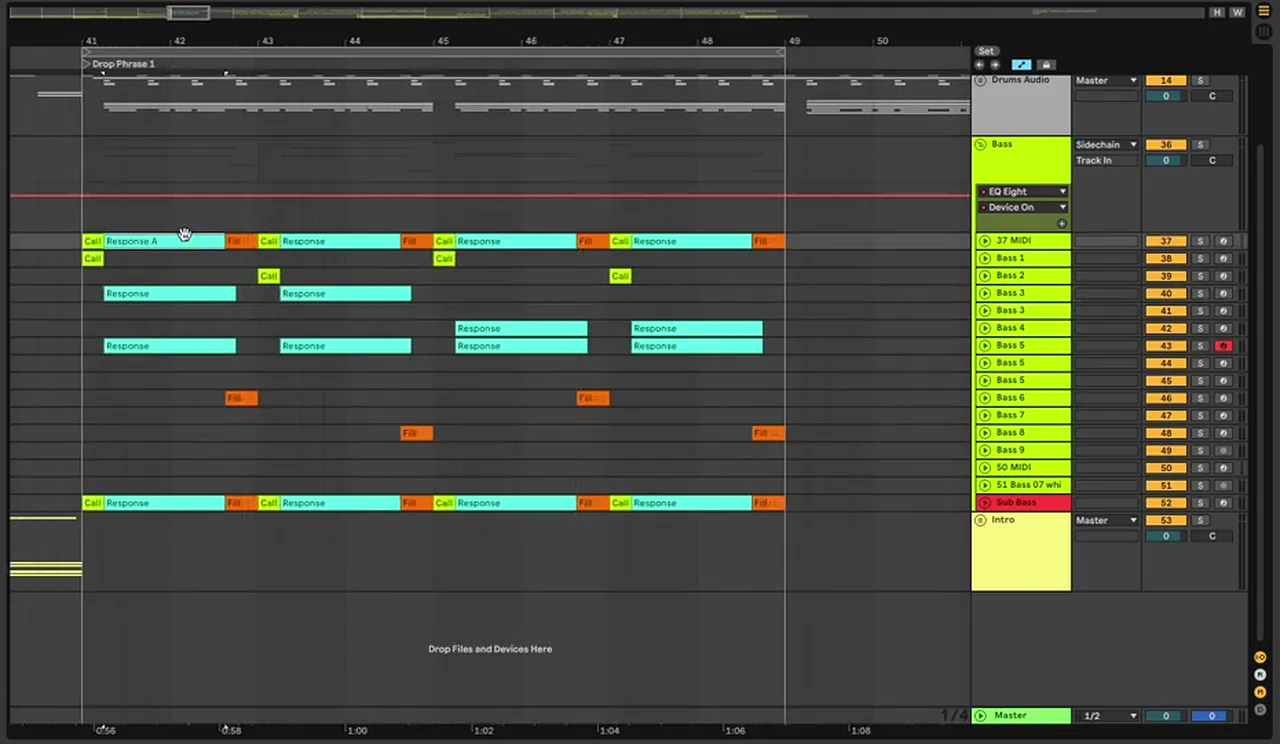
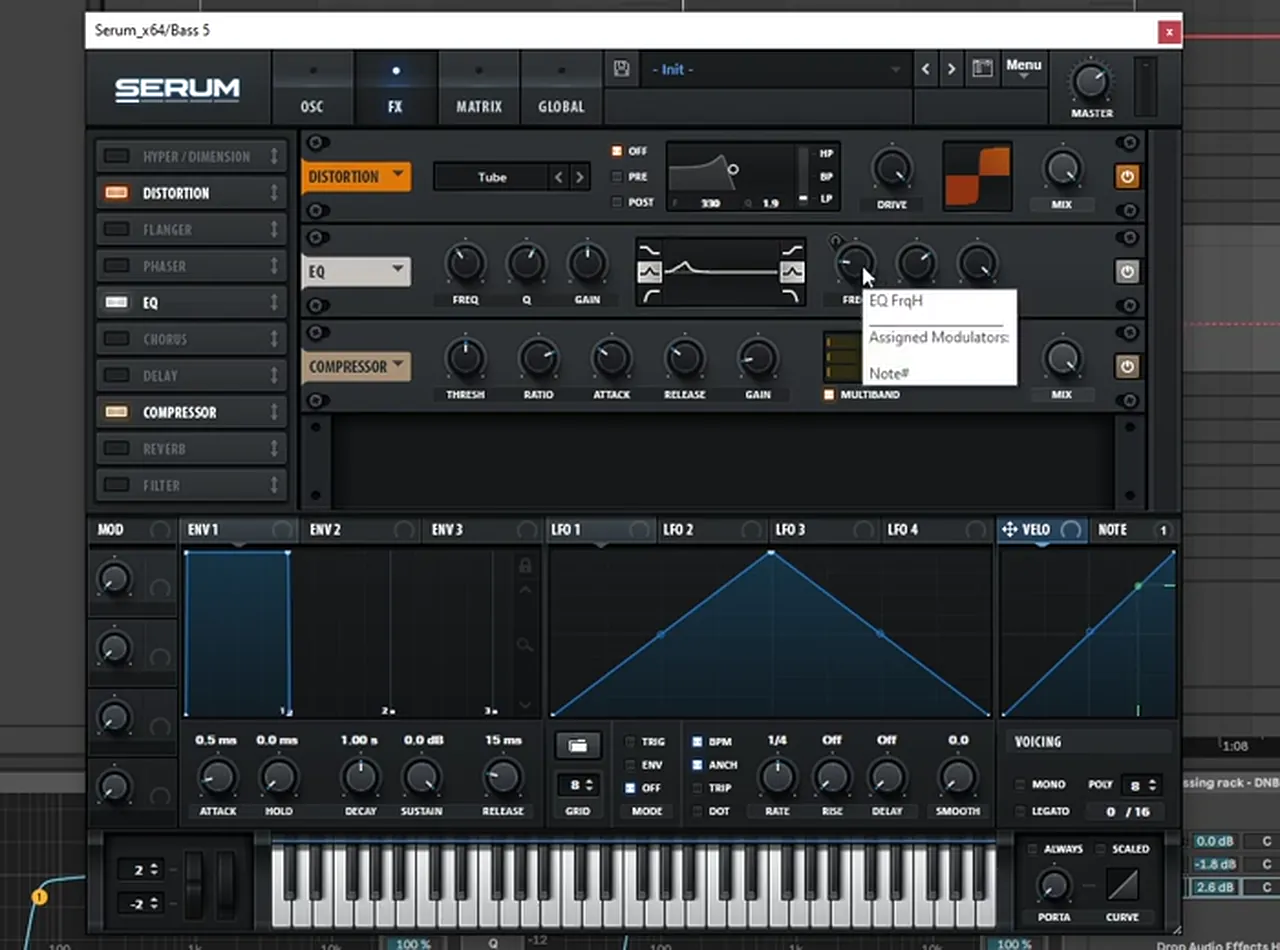
You don't always need a new sound for the variation. In the video the second response layer is varied inside the synth: changing the frequency of an EQ in the bass patch changes its tonality, so the same notes sound different.
6.Make the last bar a turnaround
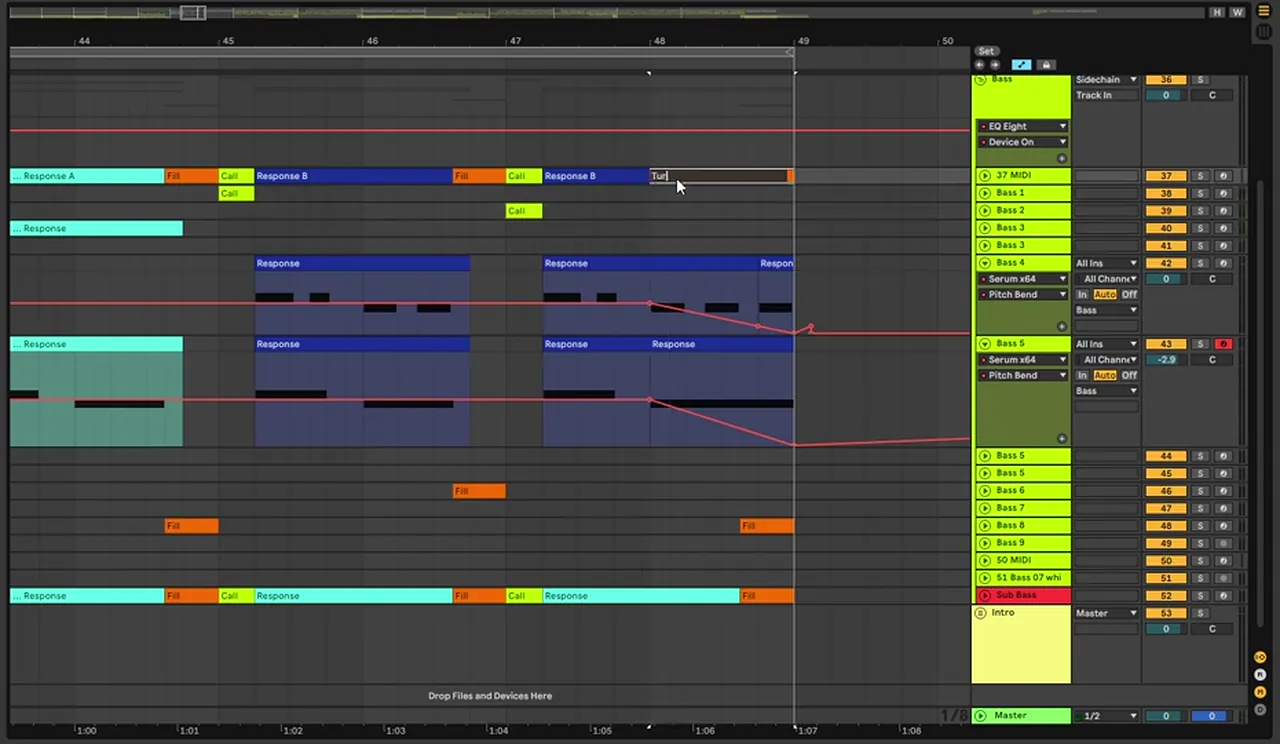
There's one more key spot. Once you have an 8-bar loop, the last bar can hold a bigger fill or turnaround that prepares the listener for the whole sequence repeating.
In the video, the response in that last bar becomes the turnaround: one bass note is made longer and pitched down (pitch bend automation), the same pitch bend is repeated on the bass layered on top, and one more hit is added that also goes down. Colour it differently so you can see it's a turnaround, not a regular response.
7.Duplicate the phrase and swap sounds again
Look at the finished structure: a call on the first beat, a response after it, a fill at the end of every 2 bars, and a turnaround on the last bar of the phrase. The rhythm repeats while the tonality of the sounds keeps changing.
To fill the rest of the drop, duplicate the whole phrase and change the sounds again. Repeating the same pattern while varying the sounds gives you a drop that's easy to follow but never feels like a copy-paste loop.
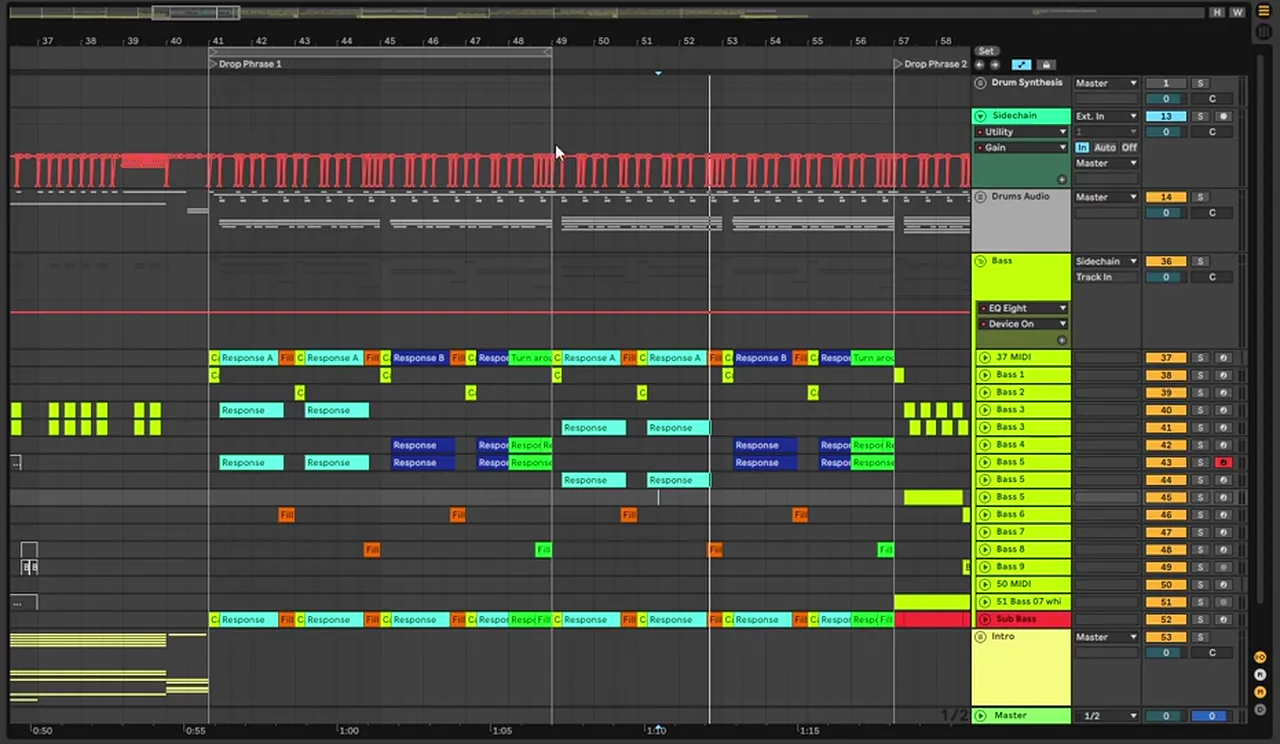
Tip: this isn't a rule for every track. It's a structure to learn the rules properly so you can break them later. Study your reference tracks: where do they put their calls, how do the responses answer, where do the turnarounds go, and when do they switch the pattern?
Once the pattern works, make sure the drums still punch through all those basses. The ducking trick in our punchy DnB drums tutorial helps.
Common mistakes
- Changing the rhythm instead of the sound. If every 2 bars has a new rhythm, the drop loses its groove. Keep the positions; change the tonality.
- No fill at the end of the pattern. Without a fill or turnaround, the repeat arrives with no warning and the loop feels static.
- Layers that are identical. A layer copied note for note adds volume, not interest. Sustain or shorten different notes so each layer has its own role.
- Forgetting the sub. If the sub doesn't follow the pattern, the drop sounds thin under all those mid basses.
- Too many sounds at once. You only need a few basses. Rotating them through fixed roles is what makes the pattern work.
Go deeper
Neurofunk sounds and courses
Need neuro basses to sequence, or want to see how artists build whole neuro drops? Start here.
 Preset bundleNeurofunk Essentials Serum preset bundleNeurofunk: Serum presets for neuro basses to sequence.
 Production courseSynergy production courseNeurofunk / Future: Synergy’s approach to neuro and future DnB.
 Production courseMaztek production courseNeurofunk: Maztek’s neurofunk production process.
Every artist course, preset bundle and sample pack is also in The Vault. Browse courses
Related tutorials
All tutorials → Ableton · NeuroHow to Make Neuro Drum and Bass in Ableton Live12 min read · Video + guide
 Serum · Bass designHow to Make a Techy Roller Bass in Serum7 min read · Video + guide
 Mixing · DrumsHow to Make DNB Drums Punchy: 3 Mixing Techniques8 min read · Video + guide
 GuideDrum & Bass Production Course: How to Learn DnB the Right Way11 min read
FAQ
How do you write a neuro bass pattern?
Use call and response in a short loop. In a 2-bar pattern, put a call bass on the first beat of bar 1, a fill on the last beat of bar 2 and response basses in between. Repeat it, swap the sounds rather than the rhythm, and finish the phrase with a turnaround.
What is call and response in drum and bass?
Call and response is when one element plays a phrase (the call) and another element answers it (the response). In neuro bass sequencing the call is often a single hit on the first beat, and the response is a short riff from a different bass.
How long should a neuro bass pattern be?
You can build patterns in 1, 2 or 4-bar periods. The video uses a 2-bar pattern repeated across an 8-bar phrase, with the call and fill changing every 2 bars, the response every 4 bars and a turnaround in the last bar.
How do I stop my DnB drop sounding repetitive?
Keep the rhythm and positions of the pattern but change the sounds: move a call to a different bass, swap the fill sound, alternate response A and B every 4 bars, or change the tone of a bass inside the synth, for example with an EQ frequency.
What is a turnaround in drum and bass?
A turnaround is a fill at the end of a phrase that prepares the listener for the repeat. In the video the last bar of the 8-bar loop gets a longer bass note that pitches down, the same pitch bend on the layered bass and one extra hit.
Next steps
This drop is one of the tracks built from scratch inside DNB Foundations. If you'd rather learn the whole process in order, here's where to go next:
Course guide
How to learn drum and bass production step by step, and which course fits your level.
Read the guide1:1 Mentorship
Personal guidance on your music from a mentor, built around your goals.
See the mentorship