
Ableton Live · Track breakdown · Artist masterclass
Molecular ‘All Systems’ Track Breakdown: How a Techy DnB Track Is Built
In this masterclass Molecular opens the Ableton project of “All Systems”, his track on Delta 9 Recordings, and shows how it’s built: a sci-fi theme that every sound serves, layered drums with breaks underneath, one simple sine-wave FM bass kept interesting with small changes, a few music elements and FX, then the drum bus and master chain. Here is the whole breakdown, step by step, with screenshots of the project and audio of the stems he solos.
Molecular presents this masterclass himself. If you want the bigger picture first, our guide to making drum and bass covers every stage of a track.
Quick answer
How is Molecular’s “All Systems” built?
Molecular starts from a theme: a 60s-style showcase of a brand-new electronic instrument, with robots taking over. The drums are layered kicks and snares with breaks and hats underneath, all sidechained so the main hits stay clean. The bass is a simple Serum patch of two sine waves with an LFO on the FM amount, split into a mono sub and a filtered mid, plus a short shimmer reverb for a metallic, robotic edge. Small changes keep it moving, and the second drop slows the LFO down.
- Theme first.Pick a vibe and let every sound serve it.
- Drums.Layered kicks and snares, breaks underneath, everything sidechained to the main hits.
- Bass.Two sine waves with LFO-driven FM, split into a clean mono sub and a filtered mid.
- Variation.Small filter, LFO and note changes, a slower LFO in the second drop.
- Music and FX.A rave stab with delay, a bit-crushed pad, vocal sample, risers and textures.
- Bus and master.Colour on the drum bus, mono lows and a limiter on the master.
Molecular’s full masterclass: the “All Systems” breakdown, then a Q&A from 48:20. Every step below links to the moment in the video.
What you’ll need
- A DAW. Molecular works in Ableton Live and uses a lot of its own devices (EQ Eight, Saturator, Utility, Auto Filter, Auto Pan). Any DAW can follow the same logic.
- A wavetable synth. The bass and pad are in Serum. The bass is only sine waves and FM, so any synth with FM can get you started; Vital is free and can do it too.
- Drum samples and breaks. Kicks, snares, hats, rides and a couple of breaks to layer underneath.
- Some colour plug-ins. The drum bus and master use third-party compressors, saturators and EQs. Molecular says himself that the master chain is more than he usually uses, so don’t treat the brands as essential.
1.Start with a theme and let it drive the arrangement
“All Systems” is built around one idea: an old-style showcase of a new electronic instrument, as if robots are taking over. The vocal sample sets that theme, and the bass, stab, pad and FX are all chosen to fit it.
Molecular plays the track first and points out the markers that map the structure (watch at 1:46): intro, second 16, drop, B part drop, drop switch, breakdown, build up, second drop, 2nd drop B, switch / A part, breakdown and last 16. The project is grouped into drums, bass, music elements and FX, with return tracks for plate, reverb, EchoBoy, parallel compression, distortion and noise. He designed almost every sound in the session; only a couple of details were frozen to audio.
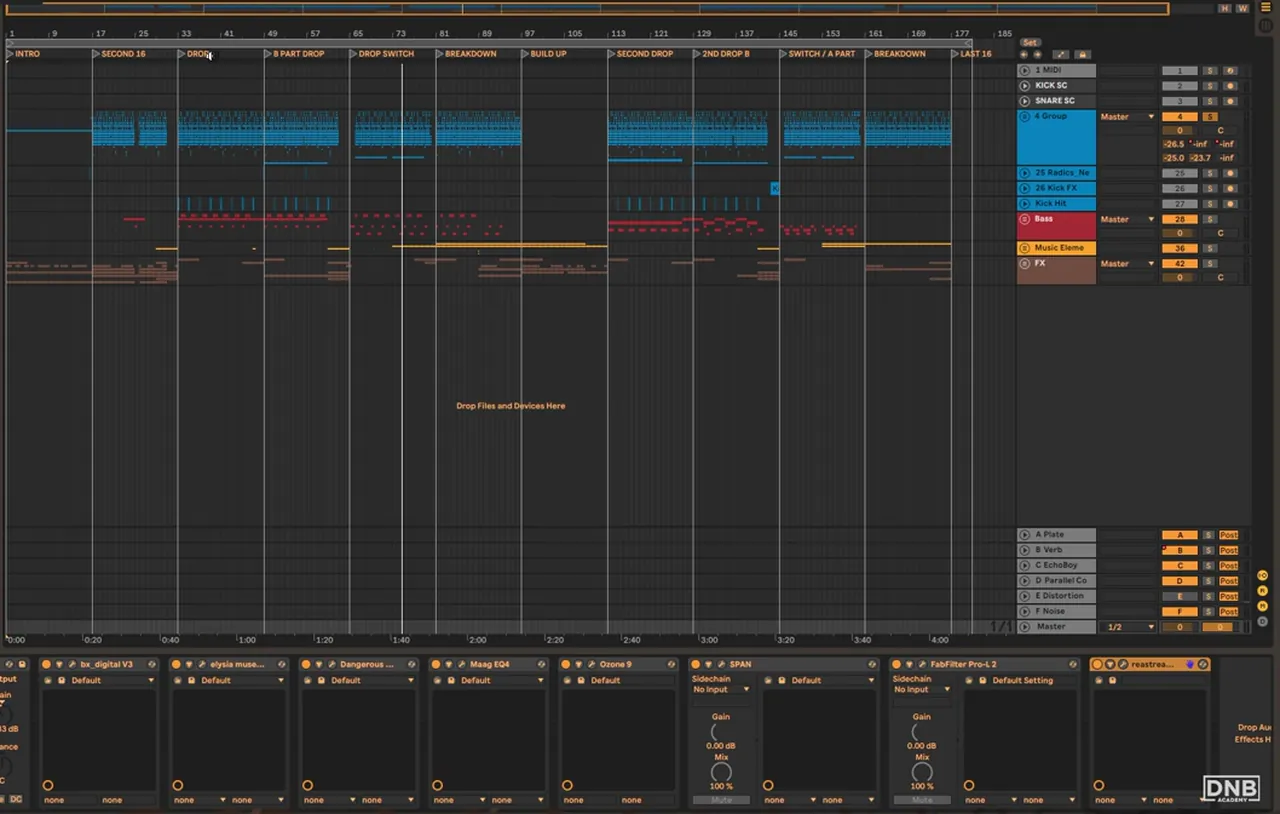
Before diving in, he makes a point worth keeping in mind for the whole breakdown (watch at 4:27): some things he did on this track he would do differently now, sidechain among them, and none of it is “the” way. Don’t copy the techniques; understand the logic behind them. Later he sums the theme up as making everything “musically make sense” together without having to process it together (watch at 31:20). For how sections like these are usually sized, see our DnB BPM and song structure guide.
2.Drums: layered kicks and a re-tuned snare
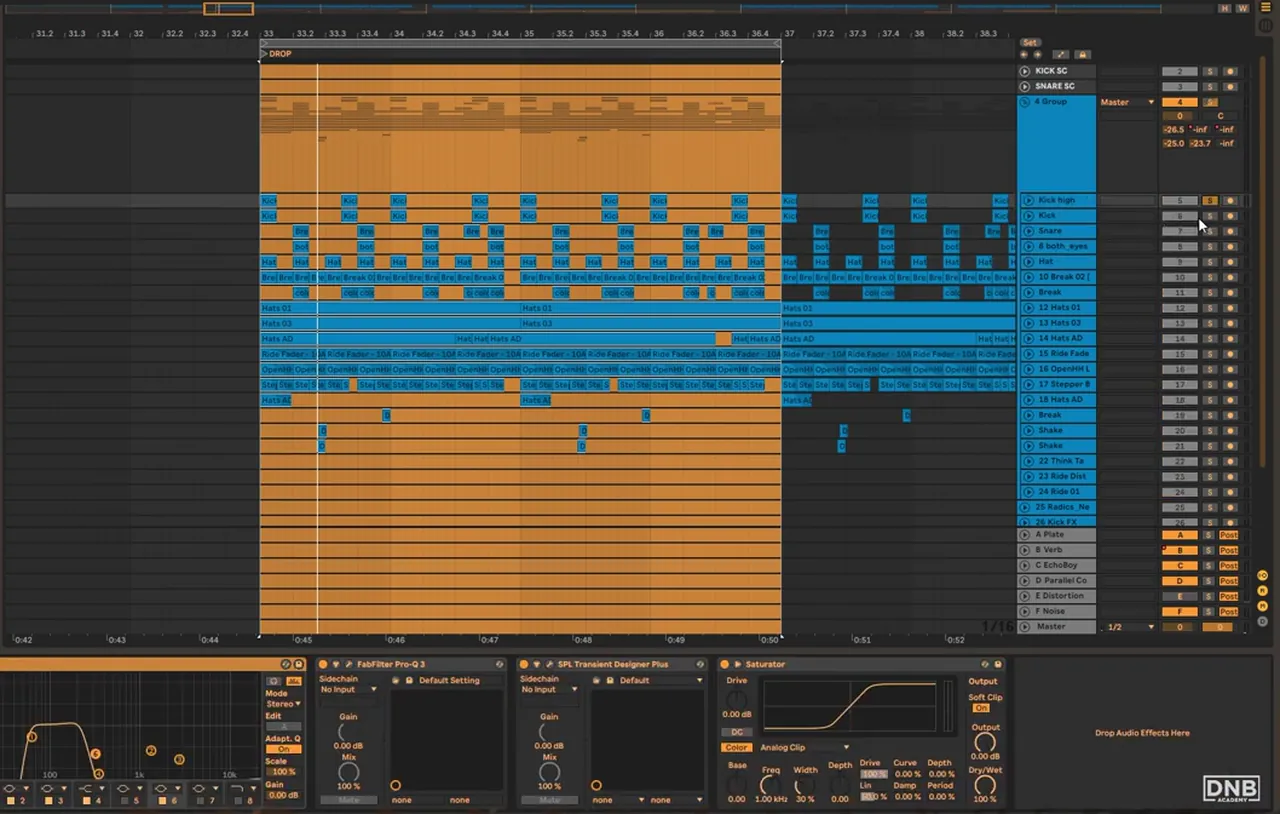
The drums group carries the most processing in the project. Two kick layers split transient and low end, and the main snare is re-tuned, shaped, EQ’d, gated and saturated before more snare layers sit on top.
Molecular solos the drums group and plays it with and without its processing (watch at 6:42). He admits he would now start with samples that already have more processing on them instead of stacking so much on the drums, which is why the project is so heavy.
Listen: the All Systems drums group soloed, as Molecular plays it from the drop8 sec
The kick is two layers (watch at 7:57): kick high, heavily EQ’d with a little transient design so it carries the attack, and kick, the very bottom end, sidechained to the other layer. He was experimenting with this layering at the time and doesn’t normally do it. Listening back, he says it may be a little too boomy in the low end and that he’d scoop that area more today.
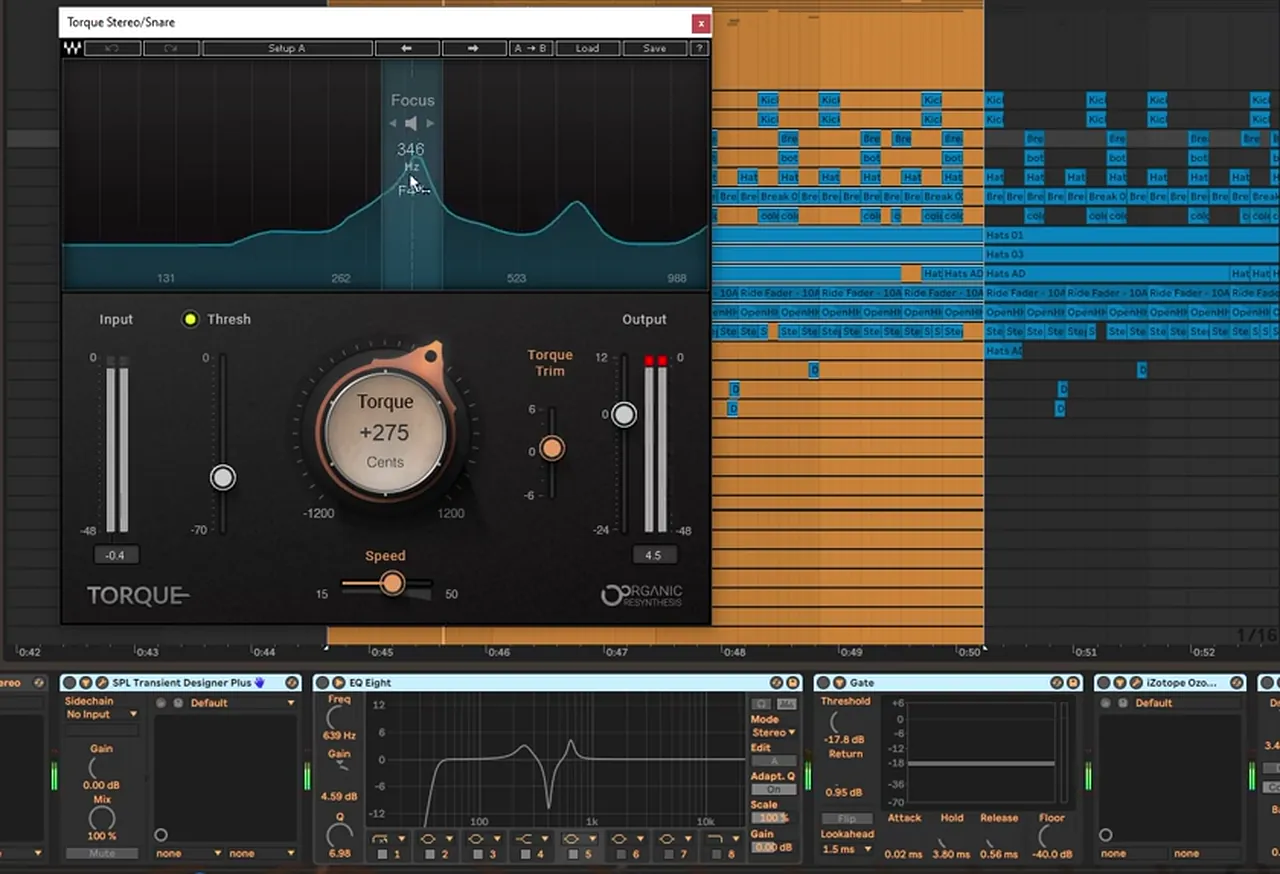
The main snare sounds very different without its chain (watch at 9:06). First comes Torque, which finds the main tone of the snare (an F4 here) and lets you shift just that tone up or down without changing the whole snare. He wanted a slightly higher-pitched snare for this track. After that: transient design, an EQ that pulls down the ringing in the mids (his other real snare layers already have information there, and he didn’t want those frequencies to pile up), a gate because the tail was a bit too long, Ozone 5 dynamics for more gating and a lift in the high mids, and a little saturation. The next snare layer gets a similar treatment: transients cut, lows EQ’d, gated, saturated and transient-shaped again.
3.Breaks, hats, ghost notes and end-of-bar switches
Under the kick and snare sit high-passed breaks, extra snare layers, hats and rides. Everything is sidechained to the kick and snare so their transients stay clean, and ghost hits and small end-of-bar switches keep the groove moving.
Layering breaks on top of the drums is a technique Molecular likes (watch at 12:09): high-pass the break, sometimes widen it a little, sidechain it and cut its transients. To keep the break in the background rather than obvious, he adds more layers: a Cold Sweat break for a little extra on the snare, more hats, hats from Addictive Drums, ride samples, open hats and more breaks. “Kick and snare, I want them to be clean,” at least the transient, so all of these layers are sidechained to the kick and snare.
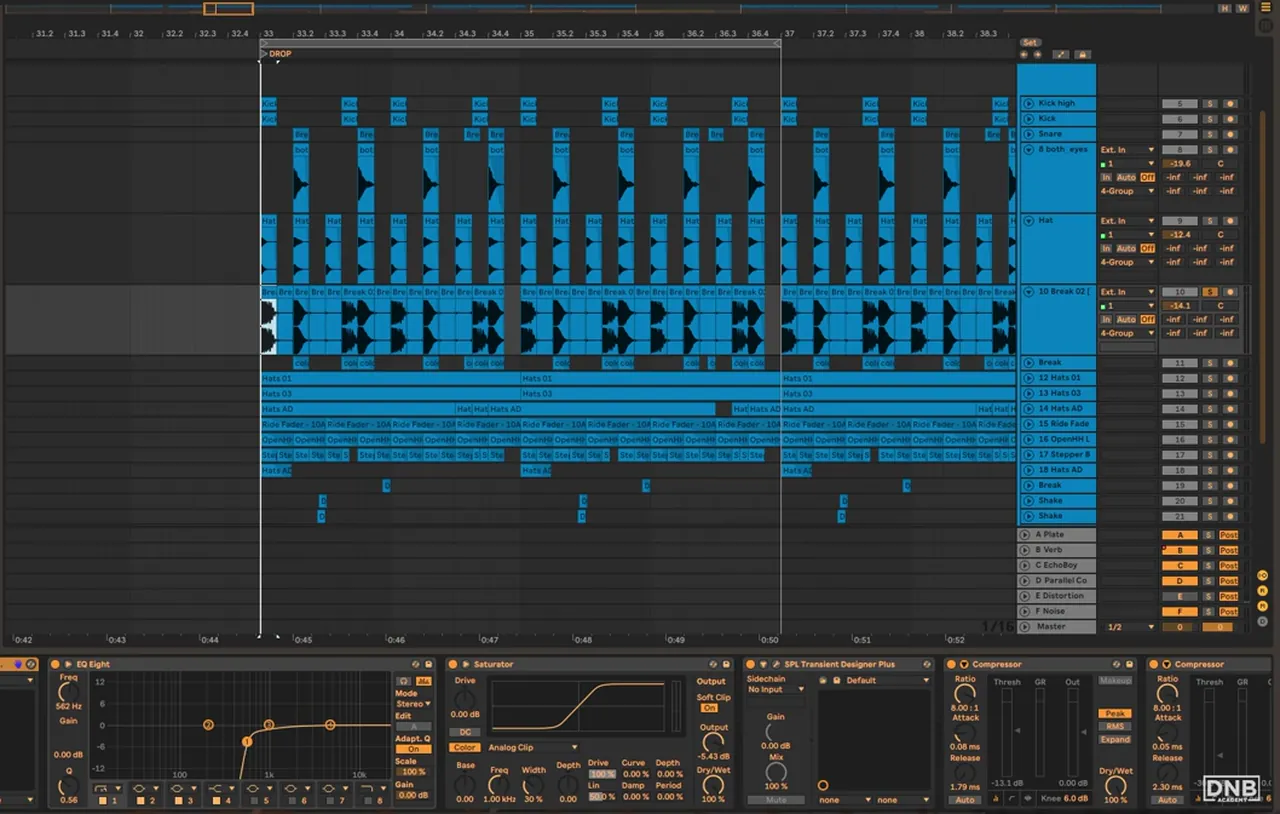
Ghost hits are “very, very important” for the funk and vibe (watch at 13:47). At the ends of bars he adds drum rolls and swaps hits: a snare where the kick should be, or a kick where the snare should be. People often overcomplicate transitions, he says, and a switch like that is already enough to catch listeners off guard. In the drop switch he adds a tambourine from the Think break, which he loves. Our DnB drum patterns guide shows where ghost notes and fills usually sit.
4.The bass: two sine waves, FM and a robotic shimmer
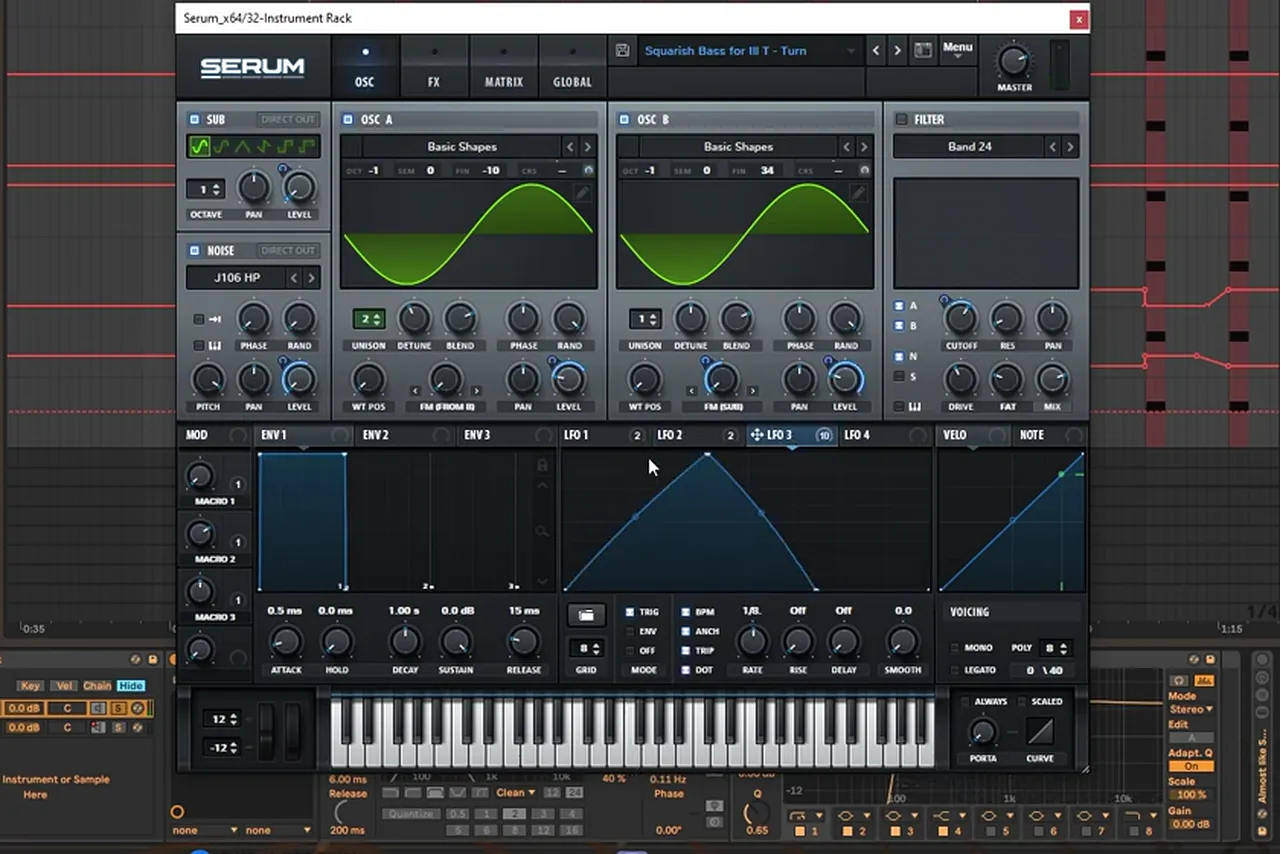
The main bass is a very simple Serum patch: two sine waves with an LFO controlling the FM amount, plus distortion, Hyper/Dimension and chorus. A duplicate with only the sub active gives a clean mono low end, and a short shimmer reverb adds the metallic, robotic tone.
The drop doesn’t give everything away at once (watch at 17:00). For the first 16 bars the bass is low-passed, and this is the only part of the project that was bounced to audio. Later the low-pass returns.
Listen: the bass group soloed at the start of the drop, with the bass still low-passed10 sec
The main bass is an Instrument Rack with two chains, sub and mid (watch at 17:59). He designed the mid-range bass, then duplicated it for the sub and turned everything off except a Serum sine wave with an LFO, a little noise and a little distortion, so the sub stays clean and mono. The mid layer runs through a band-pass filter that moves up and down from time to time.
The patch itself is “very, very simple” (watch at 20:03). LFO 1 is set up for a pitch drop but not used. The sound is two sine waves with an LFO controlling the FM amount, some distortion, Hyper/Dimension (flanger and compressor not used) and a little chorus after the distortion to smooth it out. Without the distortion and the filter it’s a completely different, classic FM sound. He does a lot of these patches: “you can get a long way with just sine waves.”
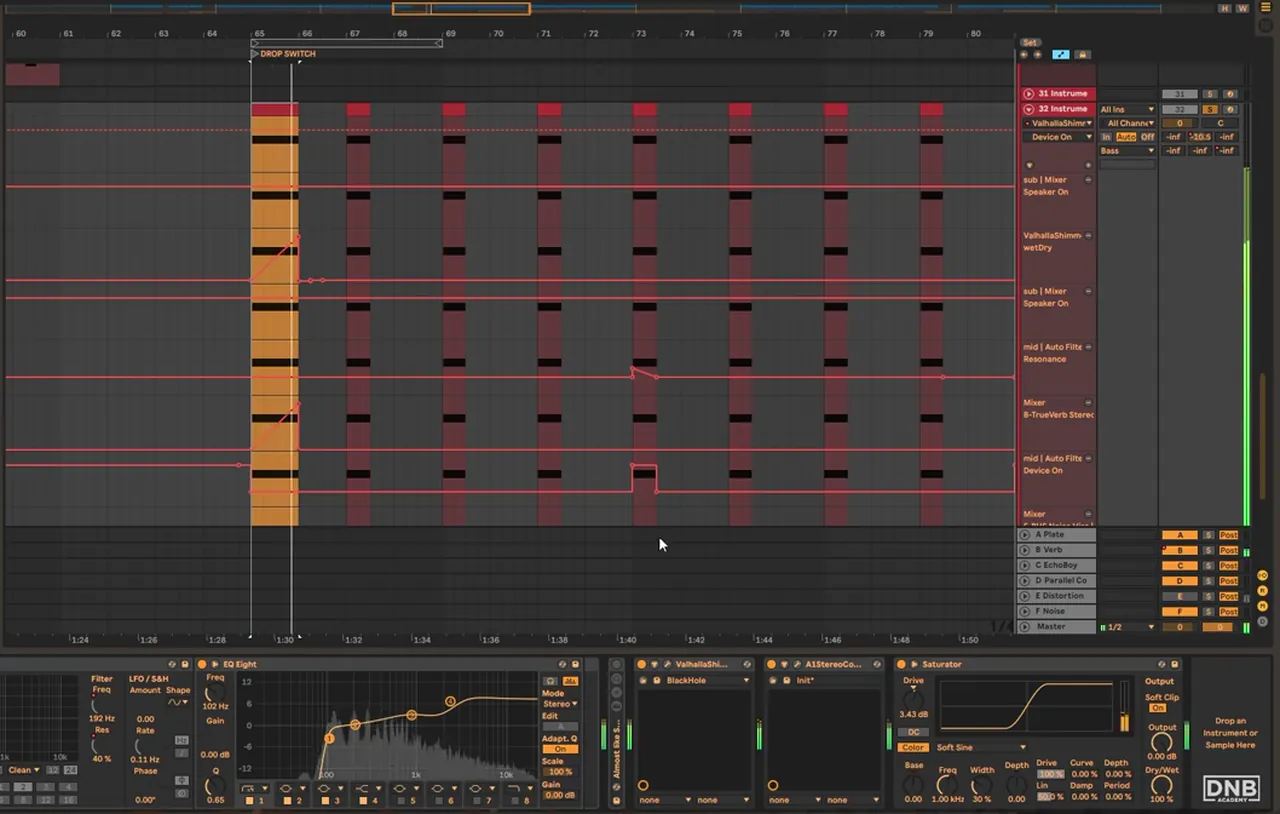
In the drop switch the bass plays without the filter, with a very short shimmer reverb (watch at 21:25). That is the metallic sound in the background, and it makes the bass feel like a robot. Molecular normally avoids shimmer on short bass reverbs: a shimmer reverb climbs up in octaves from the original note (some also go down), so on a sound that is already metallic it gets very robotic, which is exactly what this track wanted. To keep everything below 150 Hz mono he used Alex Hilton’s free A1StereoControl with its Safe Bass button at the time, but he has since found that Ableton’s Utility does it better, because Safe Bass isn’t a brick-wall cut and heavy stereo material can need several copies.
5.Keep the same bass interesting
If one sound plays for the whole track, it needs to keep changing or people get bored. Molecular uses small moves: the filter goes up or down a little, switches off for the full sound, picks up echo, and in the second drop the LFO runs much slower.
The changes are small (watch at 19:35): the filter doesn’t move far, and sometimes he just deactivates it so you hear the full sound. The answer bass is the same patch played differently, as a stabby punch instead of a wobble and without the filter (watch at 23:36). He changed its sub to a square to get more harmonics from the FM, changes the notes every four bars, and adds a filter or a little echo here and there. A detuned sine with a little saturation, from one of his own sample packs, plays later too.
In the second drop the main bass moves at a much slower rate, with the filter going down and different values every time so it never feels the same (watch at 25:39). The answer bass gets the same treatment, at different rates and with a slightly different shape that has a little punch at the start. On the bass group: sidechain, a little drive, mono again, and some clipping at the end so nothing goes over zero.
Listen: the main bass in the second drop, with the LFO running at a slower rate6 sec
Our techy roller bass in Serum tutorial is a good next step if you want to build a bass in this style from scratch.
6.Music elements: a rave stab and a bit-crushed pad
The musical layer is small: a rave stab played in a deliberately odd, playful way with a rhythmic delay, and a simple detuned-saw pad that is bit-crushed, pitched down, auto-panned and filtered.
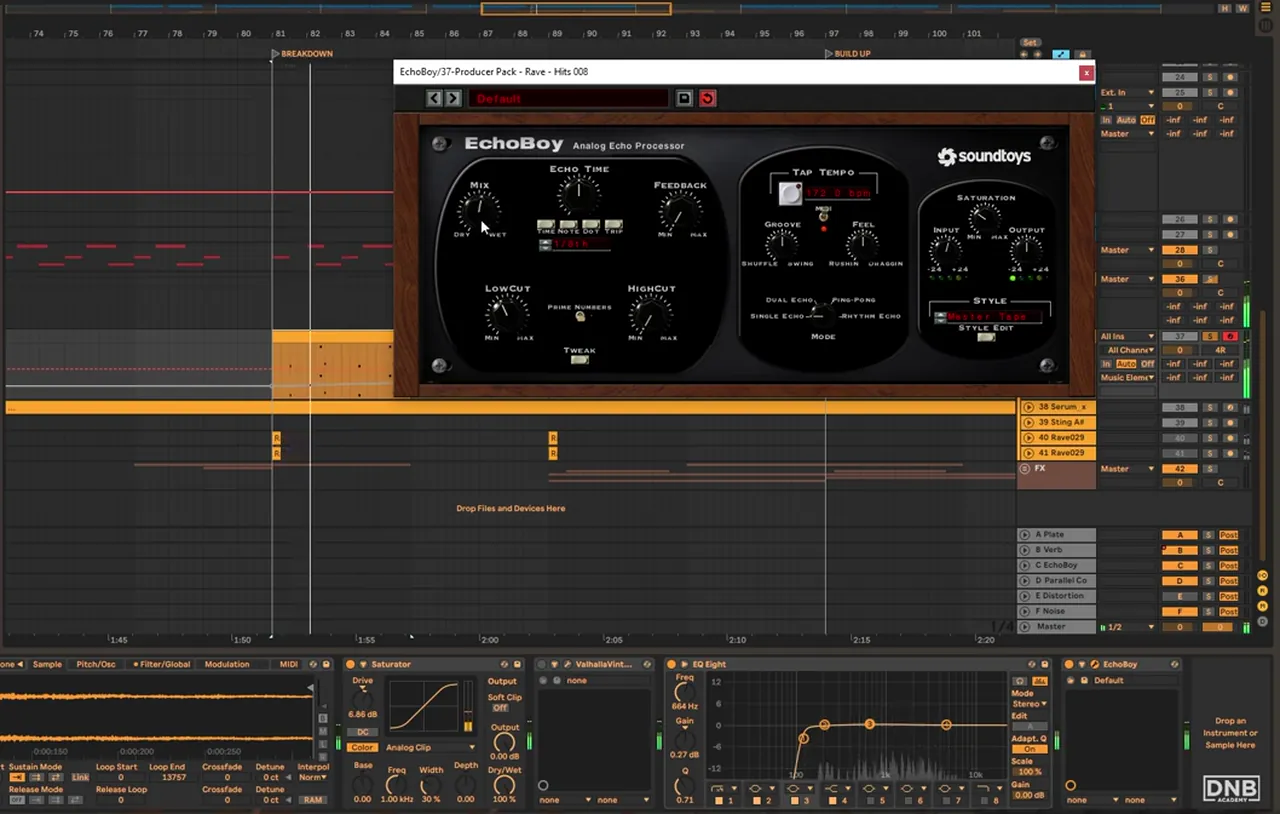
The track opens with a funny vocal, and Molecular wanted to keep that playful theme (watch at 27:59). There are tons of free rave stabs online; he dropped one in but played it in a very weird way so it doesn’t sound like an obvious rave stab. EchoBoy isn’t there for space but for rhythm: it adds another copy of the sound after the hit, because without it the part is quite boring. He prefers this to writing the extra notes in the MIDI clip, because delay repeats sound different and get filtered depending on the delay type: with more feedback, one style high-passes every repeat, another feels like a band-pass that moves down.
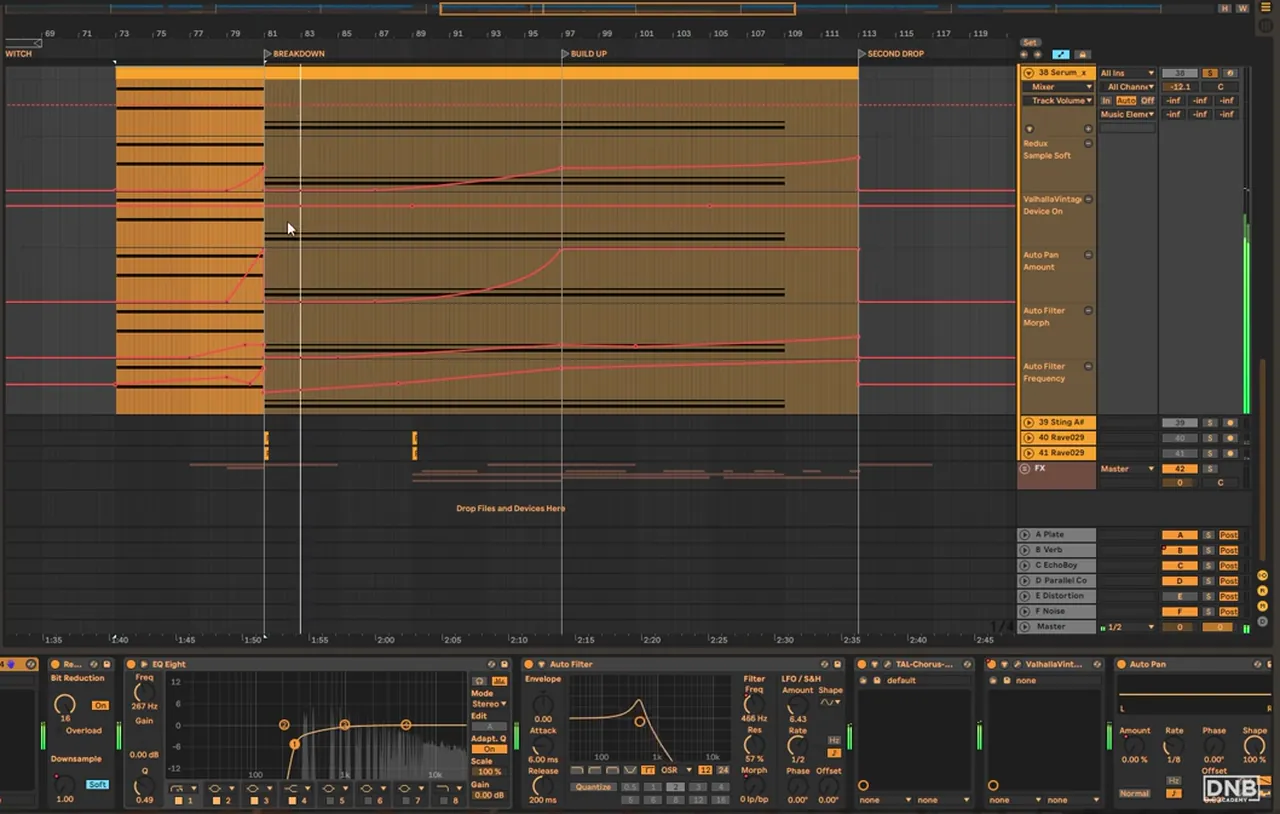
The pad is just detuned saw waves with some chorus in Serum: “that’s how hard it is to make a pad” (watch at 30:30). Then he bit-crushes it, brings the pitch down, and uses auto pan and filtering to keep it interesting while the notes climb. The bit crusher, the metallic reverb on the bass and the childish stab all add up to the robotic vibe. On the music elements group there’s a band-pass going up and nothing else; sometimes he adds a multiband there so the mids don’t distort.
7.FX and vocals: build tension around the theme
The FX group holds the vocal sample, downlifters and risers, and long textures. Most of them come from Molecular’s own sample packs, pushed through delays, filters and reverbs to build tension before the drops.
The vocal is gated to remove noise and low-end rumble from the original sample, with some shimmer reverb, a vocal synth on certain parts, and a lot of EchoBoy delay automation (watch at 33:34). If he did it again, he’d add more saturation because the vocals sometimes feel weak.
For ambient textures “anything really works” (watch at 35:00): a sound pitched down, rhythmic delay, filtering or distortion, bounced long and looped from the middle, reversed and pitched. Another sound pushes harmonics into two delays, one with pitch modulation, then more reverbs and choruses to bring out resonances. Before the drop an LFO on the Auto Filter and a rising filter (plus Crystallizer) create a pitching-up effect for tension. One more trick: exaggerated delays with an enormous amount of feedback on white noise, playing with the delay time and filter, then pitched down (watch at 38:41). He says it isn’t his technically best track, but he really likes the vibe: he wanted that “sci-fi synths are taking over” feel, and it worked.
8.The drum bus: compression, saturation and Pultec-style EQ
The drums group runs a bus compressor at about 8 dB of gain reduction, several saturators, a console strip, a Pultec-style EQ, a filter, a de-esser and a soft clip. It’s a lot of colour, and Molecular explains what each stage adds.
He uses Brainworx’s bus compressor (watch at 42:38). He normally tries to avoid heavy compression on drums, and 8 dB of gain reduction is a lot, but it emulates a tube compressor, so it also saturates and makes the drums sound fat even with just the makeup gain up. Then saturation, and a saturator that treats mids and sides separately: not a secret sauce (he doesn’t use much mid-side), it just makes the tops feel wider and the background fuller. A console plug-in adds a little top end, a high-pass and saturation.
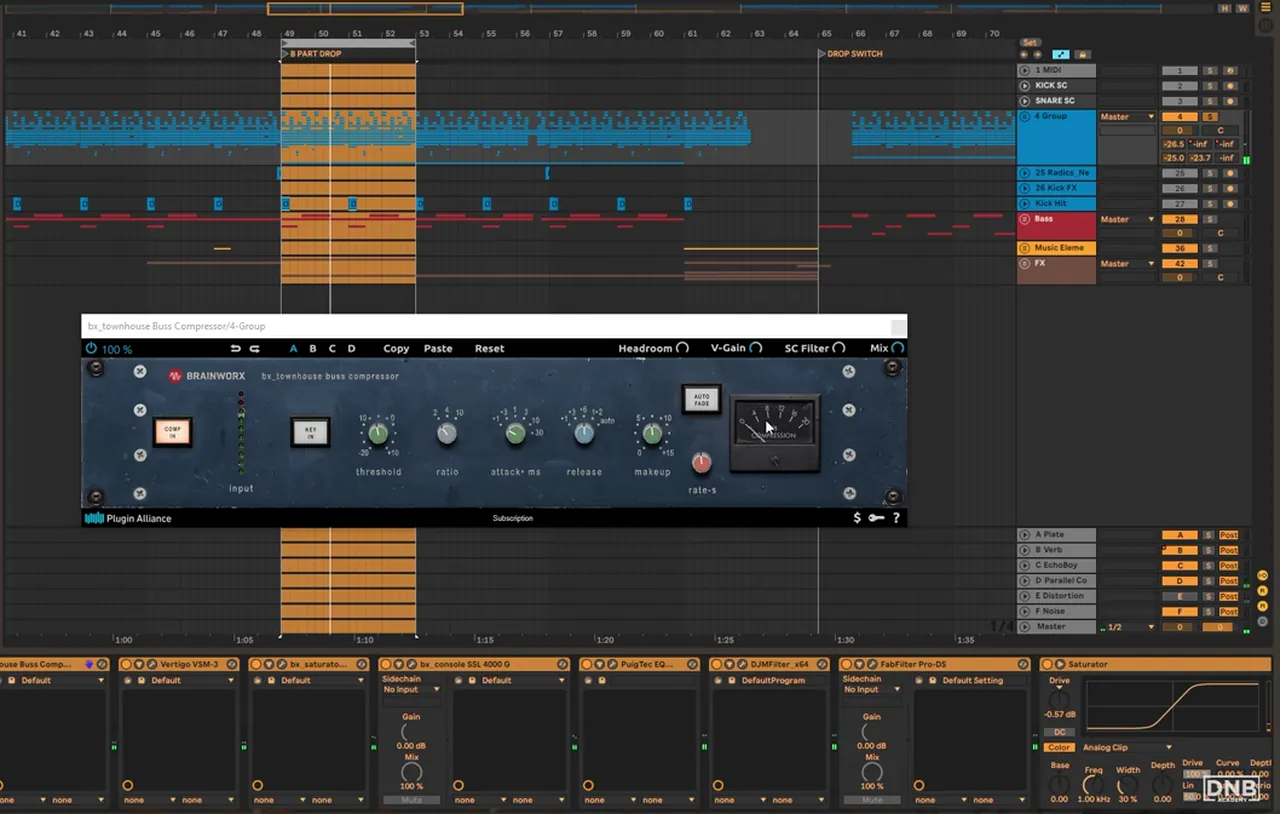
Next is a Pultec emulation (watch at 44:37). Drive it too hard and it starts mangling the sound; he boosts a little top end, and on the sub he boosts and attenuates by almost the same amount, which changes the low end a lot because the boost and cut curves are different. He has never used a real one and says there are good free Pultec-style emulations. Last: a filter he uses from time to time, a de-esser on the highs (today he’d use a multiband compressor instead) and a soft clip, pulled down a little because it was driving too much. For a full mixdown process, see our guide to mixing drum and bass.
9.The master chain: mono lows, a little colour, a limiter
On the master, everything below 150 Hz is made mono, a few EQs add top end, low end and air, and Ozone plus a limiter keep it from clipping. Molecular says this is more than he usually does: often it’s just a limiter or a clipper.
The chain (watch at 40:14): an EQ that seems to do nothing but makes everything below 150 Hz mono, an elysia EQ for a little more top end on the stereo, Dangerous BAX for a bit of low end, a Maag EQ for more air, Ozone doing a little limiting, and Pro-L at the end so nothing clips. Bypass the limiter and the track will seem worse simply because it’s quieter, so his warning applies to plug-in shopping too: louder sounds better to our ears, so try a plug-in yourself first.
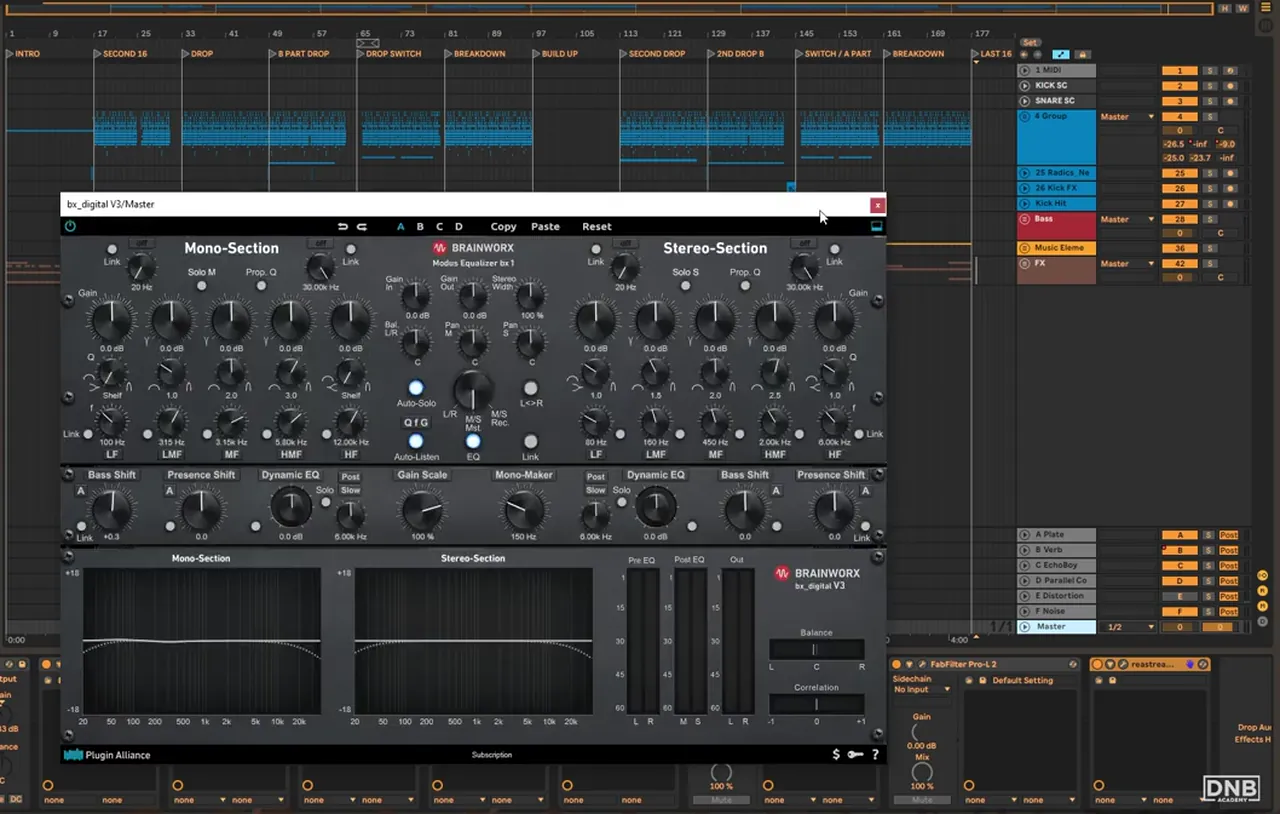
In the Q&A he adds that this isn’t really a mastering chain, just making the track loud and a bit better. Mastering is a different subject; inside a track he’d usually use fewer EQs and then just a limiter or a clipper (watch at 56:52).
Common mistakes Molecular points out
- Copying the settings instead of the logic. Every producer works differently. Understand why a step is there.
- Compressing because someone online does. Compress only when a sound needs it; it can destroy the sound.
- Over-processing single hits. He’d now start from samples that already have more processing on them.
- Dirty kick and snare transients. Sidechain the breaks, hats and rides to the main hits.
- Overcomplicated transitions. A snare where the kick should be is often enough.
- One bass, unchanged, for the whole track. Small filter, LFO and note changes keep it alive.
- Judging plug-ins by loudness. Louder sounds better. Level-match and try it yourself.
Free download
Free neuro drums and bass to layer
Want sounds to try these layering and processing ideas on? The Tentacles Neuro DnB Starter Pack gives you:
- 15 kicks, snares and top loops for heavy drums
- 25 neuro bass samples
- 10 FX samples
- 50 royalty-free samples, with Ableton project files
It’s one of seven free sample and preset packs in DNB Academy Free Access, alongside the mixing and mastering e-books and the 3‑day DnB challenge. Join 40,000+ producers in Free Access. Free account, no card needed.
Go deeper
Molecular’s course and techy Serum presets
Want to see Molecular build full tracks, or start from techy bass presets?
 Production courseMolecular production courseTwo techy DnB tracks built from scratch in 14+ hours, with lessons on filling out the drops and arrangement, plus project files, stems, samples, presets and Ableton racks.
 Preset bundle · SerumBristol Tech Serum preset bundleTechy / Rollers: Serum presets for techy rollers.
Every artist course, preset bundle and sample pack is also in The Vault. Browse courses
Related tutorials
All tutorials → Ableton · ArrangementHow to Turn a Loop into a Drum and Bass Drop (with Icicle & Molecular)12 min read · Guide
 Ableton · NeuroHow to Make Neuro Drum and Bass in Ableton Live12 min read · Video + guide
 Serum · LeadsHow to Make a Lead Like Camo & Krooked and Mefjus’ “No Tomorrow” in Serum7 min read · Video + guide
 Guide · MixingHow to Mix Drum and Bass: A Mixdown Guide for DnB19 min read · Guide
FAQ: Molecular’s “All Systems” breakdown and Q&A
What is Molecular’s “All Systems”?
It’s a techy drum and bass track by Molecular, released on Delta 9 Recordings as part of the label’s 100th release. In this masterclass he opens the Ableton Live project and walks through the drums, the bass, the music elements, the FX and vocals, the drum bus and the master chain, then answers questions from the community.
What are Molecular’s go-to drum processing tools?
In the Q&A he says the most important things are EQ and saturation, for single hits and for the drum bus. Transient shaping matters if the drums need it. He only compresses when a sound actually needs it, because compressing just because someone online does it can destroy the sound.
Do you have to synthesize every sound yourself?
No. Molecular tries to make his drums and bass himself so he can tailor them, but he says catching a vibe matters much more than synthesizing everything. If you start with good samples, your mixdown also gets a lot easier.
How does Molecular approach a mixdown?
He mixes as he goes: from the first four or eight bar loop he already sets levels, so by the end of the arrangement there is only a little mixing left. For him a mixdown is volumes, EQ and space, and he suggests checking how loud each instrument is in music you think is well made.
How do you keep a simple bass interesting for a whole track?
Make lots of small changes. In “All Systems” the same FM bass runs through a filter that moves a little, switches off for some bars, picks up echo or a different filter, and in the second drop its LFO runs at a slower rate with different values each time.
Does Molecular start a track with the drop or the intro?
Normally with the drop. Sometimes he starts with bass sounds or drums, and if he already has a specific idea he lays it down as quickly as he can and then works on everything else.
Next steps
Pick a theme for your next track and check every sound against it. Then try the bass idea: two sines, an LFO on the FM amount, a clean mono sub, and a list of small changes for each section. Molecular’s Q&A advice ties it together: learn what each process does before you use it. Techy tracks like this sit close to neuro; our drum and bass subgenres guide explains the neighbours.
Free Access
Seven free DnB sample and preset packs, including the Tentacles Neuro DnB Starter Pack, plus mixing and mastering e-books and a 3-day challenge for Ableton Live and FL Studio.
Get free packsThe full guide
Tempo, drums, sub, mid bass, chords, arrangement and mixdown: every step of a DnB track.
Read the guideDNB Foundations
A structured drum and bass course with weekly live feedback calls on your tracks.
See Foundations1:1 Mentorship
Personal guidance on your music from a mentor, built around your goals.
See the mentorship50,000+ producers have joined DNB Academy, and our producer Discord has 5,300+ members.